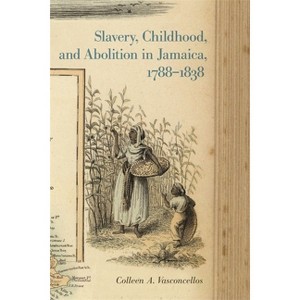
This study examines childhood and slavery in Jamaica from the onset of improved conditions for the island's slaves to the end of all forced or coerced labor throughout the British Caribbean.
About the Author: COLLEEN A. VASCONCELLOS is an associate professor of history at the University of West Georgia.
176 Pages
Social Science, Slavery
Series Name: Early American Places
Description
About the Book
"This project examines childhood and slavery in Jamaica from 1750, when abolitionist sentiment began to take hold in England, to 1838, when slavery finally ended on the island. By focusing specifically on the changing nature of slave childhood in Jamaica, Vasconcellos examines how childhood and slavery influenced and changed each other throughout this period of study, with the abolitionist movement standing as the main catalyst for change. With each chapter focusing on a different aspect of the slave experience, this monograph explores a childhood that was defined by planter opinion and manipulation, but one that was increasingly affected by the complex processes of slavery, abolition, and eventually emancipation. In doing so, this study reveals a great deal about slave family and childhood from the inside, shining new light on the experiences of slave children and slave families in Jamaica"--Provided by publisher.
Book Synopsis
This study examines childhood and slavery in Jamaica from the onset of improved conditions for the island's slaves to the end of all forced or coerced labor throughout the British Caribbean. As Colleen A. Vasconcellos discusses the nature of child development in the plantation complex, she looks at how both colonial Jamaican society and the slave community conceived childhood--and how those ideas changed as the abolitionist movement gained power, the fortunes of planters rose and fell, and the nature of work on Jamaica's estates evolved from slavery to apprenticeship to free labor. Vasconcellos explores the experiences of enslaved children through the lenses of family, resistance, race, status, culture, education, and freedom. In the half-century covered by her study, Jamaican planters alternately saw enslaved children as burdens or investments. At the same time, the childhood experience was shaped by the ethnically, linguistically, and culturally diverse slave community.
Vasconcellos adds detail and meaning to these tensions by looking, for instance, at enslaved children of color, legally termed mulattos, who had unique ties to both slave and planter families. In addition, she shows how traditions, beliefs, and practices within the slave community undermined planters' efforts to ensure a compliant workforce by instilling Christian values in enslaved children. These are just a few of the ways that Vasconcellos reveals an overlooked childhood--one that was often defined by Jamaican planters but always contested and redefined by the slaves themselves.
Review Quotes
Slavery, Childhood, and Abolition in Jamaica adds considerably to our understanding of how amelioration altered the actions of slave owners in fundamental ways. Vasconcellos has a number of fresh ideas on the significance of childhood as a political and, to an extent, a social issue in the transition from slavery to freedom in eighteenth- and nineteenth-century Jamaica.--Trevor Burnard "author of Creole Gentlemen: The Maryland Elite, 1691-1776"
Well researched and elegantly written, Colleen Vasconcellos's Slavery, Childhood and Abolition in Jamaica broadens Atlantic discussions of childhood by providing insights into the political, socioeconomic, and cultural factors that shaped enslaved children in the British Caribbean.--Shani Roper "Journal of the History of Childhood and Youth"
Colleen Vasconcellos's exploration of the shifting experiences of enslaved children, the most vulnerable section of the plantation population, manages to illuminate ways that successive 'reforms' impacted their lives. She offers a plantation-level perspective on the changing repercussions for individual enslaved households of the successive reform efforts, running from the first questioning of slavery in the mid-eighteenth century, through efforts to legislate reforms via individual colonial legislatures, to the colonial repercussions of the ending of the transatlantic trade in enslaved Africans, and then on to the transition from emancipation to "Full Free."--James Robertson, department of history and archaeology, The University of West Indies, Mona
About the Author
COLLEEN A. VASCONCELLOS is an associate professor of history at the University of West Georgia. She is coeditor, with Jennifer Hillman Helgren, of Girlhood: A Global History.
Dimensions (Overall): 8.9 Inches (H) x 6.0 Inches (W) x .6 Inches (D)
Weight: .6 Pounds
Suggested Age: 22 Years and Up
Number of Pages: 176
Genre: Social Science
Sub-Genre: Slavery
Series Title: Early American Places
Publisher: University of Georgia Press
Format: Paperback
Author: Colleen A Vasconcellos
Language: English
Street Date: May 15, 2015
TCIN: 88984502
UPC: 9780820348056
Item Number (DPCI): 247-57-9485
Origin: Made in the USA or Imported
If the item details aren’t accurate or complete, we want to know about it.
Shipping details
Estimated ship dimensions: 0.6 inches length x 6 inches width x 8.9 inches height
Estimated ship weight: 0.6 pounds
We regret that this item cannot be shipped to PO Boxes.
This item cannot be shipped to the following locations: American Samoa (see also separate entry under AS), Guam (see also separate entry under GU), Northern Mariana Islands, Puerto Rico (see also separate entry under PR), United States Minor Outlying Islands, Virgin Islands, U.S., APO/FPO
Return details
This item can be returned to any Target store or Target.com.
This item must be returned within 90 days of the date it was purchased in store, shipped, delivered by a Shipt shopper, or made ready for pickup.