Sponsored
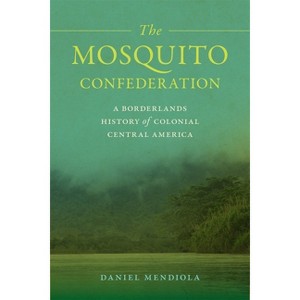
The Mosquito Confederation - Early American Places by Daniel Mendiola
In Stock
Sponsored
About this item
Highlights
- The Mosquito Confederation is the first historical monograph to offer a thorough, chronological narrative of the rise and decline of the Mosquito Confederation: a powerful alliance of Amerindian and African-descended peoples that dominated much of Central America's Caribbean coast throughout the eighteenth century.
- About the Author: DANIEL MENDIOLA is an assistant professor of history at Vassar College.
- 256 Pages
- History, Native American
- Series Name: Early American Places
Description
About the Book
"Relying on extensive new archival discoveries, The Mosquito Confederation demonstrates that the rise and decline of the Mosquito Confederation was not merely a footnote in Central American history, nor was the confederation relegated to the margins of the colonial world. Indeed, the Mosquito were protagonists in shaping the region's complex history, and the confederation's expansionist geopolitical program represented a "conquest in its own right." In describing these processes, Mendiola excavates the roles of diverse peoples in Central America's Caribbean borderlands including "thoughtful Mosquito leaders who balanced complex geopolitical considerations, Afro-descended Central Americans who shaped Spanish and English responses to the Mosquito, and Amerindians who moved among Spanish, English, and Mosquito worlds"--
Book Synopsis
The Mosquito Confederation is the first historical monograph to offer a thorough, chronological narrative of the rise and decline of the Mosquito Confederation: a powerful alliance of Amerindian and African-descended peoples that dominated much of Central America's Caribbean coast throughout the eighteenth century.
This study addresses a straightforward set of questions: Who were the principal actors facilitating Mosquito expansion? What specific practices did they implement? And how did these processes shape the competing Spanish and English conquests in the region?
The specific answers to these questions vary over place and time, yet the overarching argument is that the rise and decline of the Mosquito Confederation--a process that depended far more on the novel practices of Mosquito leaders than on outside, colonial influences--was the driving force shaping imperial outcomes in the region. This research derives from a substantial body of previously uncited sources, especially from the National Archive of Costa Rica. Since Mosquito fleets routinely stopped in Costa Rican ports to trade and gather supplies, the Costa Rican archival record is both uniquely large and uniquely insightful. These sources fill critical gaps in Mosquito history, especially in the first half of the century, making it possible for the first time to write a chronological narrative of contextualized events throughout the century.
Review Quotes
Daniel Mendiola convincingly challenges some long-standing assumptions about Mosquito history using both novel sources as well as innovative interpretations of known sources.--Barbara Potthast "author of Lateinamerika seit 1930"
This history overturns myths and unwarranted assumptions about Mosquito activities, especially Mosquito relations with the Spanish in the Matina Valley of Costa Rica. Mendiola will force scholars to take Costa Rica more seriously and, more importantly, consider the idea of the Mosquito people as conquerors along with the Spaniards and British.--Karl Offen "coeditor of The Awakening Coast: An Anthology of Moravian Writings from Mosquitia and Eastern Nicaragua, 1849-1899."
About the Author
DANIEL MENDIOLA is an assistant professor of history at Vassar College.
Shipping details
Return details
Frequently bought together


Guests also viewed



Discover more options