Target New ArrivalsGift Ideas for DadClothing, Shoes & AccessoriesHome & DecorKitchen & DiningOutdoor Living & GardenGroceryHousehold EssentialsBabyBeautyPersonal CareSports & OutdoorsHealthWellnessLuggageSchool & Office SuppliesToysElectronicsVideo GamesMovies, Music & BooksParty SuppliesGift IdeasGift CardsPetsUlta Beauty at TargetShop by CommunityTarget OpticalDealsClearanceNew ArrivalsGift Ideas for DadBack to SchoolCollegeTop DealsTarget Circle DealsWeekly AdShop Order PickupShop Same Day DeliveryRegistryRedCardTarget CircleFind Stores
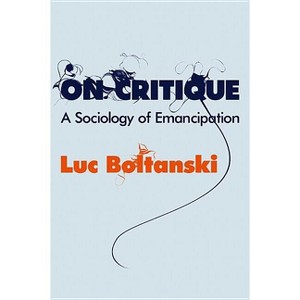
On Critique - by  Luc Boltanski (Paperback) - 1 of 1

On Critique - by Luc Boltanski (Paperback)

$23.99Save $0.96 (4% off)

In Stock

Free & easy returns

Free & easy returns

Return this item by mail or in store within 90 days for a full refund.
Eligible for registries and wish lists

About this item

Highlights

  • The relationship between sociology and social critique has haunted the discipline since its origins.
  • About the Author: Luc Boltanski is Professor of Sociology at the École des hautes études en sciences sociales, Paris
  • 200 Pages
  • Social Science, Sociology

Description


About the Book


In this major new book Boltanski develops a framework that makes it possible to reconcile these seemingly antagonistic approaches - the one determinist and assigning the leading role to the enlightening science of the sociologist, the other concerned to stick as closely as possible to what people say and do.


Book Synopsis


The relationship between sociology and social critique has haunted the discipline since its origins. Does critique divert sociology from its scientific project? Or is critique the ultimate goal of sociology, without which the latter would be a futile activity disconnected from the concerns of ordinary people? This issue has underpinned two divergent theoretical orientations that can be found in the discipline today: the critical sociology that was developed in its most elaborate form by Pierre Bourdieu, and the pragmatic sociology of critique developed by Luc Boltanski and his associates.

In critical sociology, description in terms of power relations underscores the potency of mechanisms of oppression, the way the oppressed passively endure them, going so far in their alienation as to
adopt the values that enslave them. Pragmatic sociology, by contrast, describes the actions of human beings who rebel but who are endowed with reason. It stresses their ability, in certain historical conditions, to rise up against their domination and construct new interpretations of reality in the service of critical activity.

In this major new book Boltanski develops a framework that makes it possible to reconcile these seemingly antagonistic approaches - the one determinist and assigning the leading role to the enlightening science of the sociologist, the other concerned to stick as closely as possible to what people say and do. This labour of unification leads him to rework central notions such as practice, institution, critique and, finally, 'social reality, ' all with the aim of contributing to a contemporary renewal of practices of emancipation.


From the Back Cover


Does critique divert sociology from its scientific project? Or is critique the ultimate goal of sociology, without which the latter would be a futile activity disconnected from the concerns of ordinary people? This issue underpins two divergent theoretical orientations that can be found in the discipline today: the critical sociology developed in its most elaborate form by Pierre Bourdieu, and the pragmatic sociology of critique developed by Luc Boltanski and his associates.

In critical sociology, description in terms of power relations underscores the potency of mechanisms of oppression, the way the oppressed passively endure them, going so far in their alienation as to adopt the values that enslave them. Pragmatic sociology, by contrast, describes the actions of human beings who rebel but who are endowed with reason. It stresses their ability to rise up against domination and construct new interpretations of reality in the service of critical activity.

Boltanski develops a framework that makes it possible to reconcile seemingly antagonistic approaches - one determinist and assigning the leading role to the enlightening science of the sociologist, the other concerned to stick as closely as possible to what people say and do. This labour of unification leads
him to rework such notions as practice, institution, critique and, finally, 'social reality', all with the aim of contributing to a contemporary renewal of practices of emancipation.


Review Quotes


"This work of depth and originality represents a major step in Luc Boltanski's remarkable intellectual trajectory. Having moved from Bourdieusian 'critical sociology' to pragmatic 'sociology of critique, ' Boltanski now seeks to develop a third approach, overcoming the weaknesses of both. The result is a powerful conception of critique, grounded in the radical uncertainty that underlies social life and in the contradictory efforts of institutions to defuse it. On Critique seals his reputation as the leading philosophical sociologist of our era."
Nancy Fraser, New School for Social Research

"With surprising sociological imagination, Boltanski shows how the critique of institutions is based on the everyday experience of a discrepancy between reality and the world, between what is socially defined and what could be possible in an undefined way. Without intending to, Boltanski revitalizes Adorno's insights in a sociological manner. This book is to be read by everyone interested in the future of critical theory."
Axel Honneth, Johann Wolfgang Goethe University, Frankfurt


About the Author


Luc Boltanski is Professor of Sociology at the École des hautes études en sciences sociales, Paris

Dimensions (Overall): 8.9 Inches (H) x 5.9 Inches (W) x .6 Inches (D)
Weight: .7 Pounds
Suggested Age: 22 Years and Up
Number of Pages: 200
Genre: Social Science
Sub-Genre: Sociology
Publisher: Polity Press
Theme: General
Format: Paperback
Author: Luc Boltanski
Language: English
Street Date: April 18, 2011
TCIN: 1010128920
UPC: 9780745649641
Item Number (DPCI): 247-12-4748
Origin: Made in the USA or Imported
If the item details aren’t accurate or complete, we want to know about it.

Shipping details

Estimated ship dimensions: 0.6 inches length x 5.9 inches width x 8.9 inches height
Estimated ship weight: 0.7 pounds
We regret that this item cannot be shipped to PO Boxes.
This item cannot be shipped to the following locations: American Samoa (see also separate entry under AS), Guam (see also separate entry under GU), Northern Mariana Islands, Puerto Rico (see also separate entry under PR), United States Minor Outlying Islands, Virgin Islands, U.S., APO/FPO, Alaska, Hawaii

Return details

This item can be returned to any Target store or Target.com.
This item must be returned within 90 days of the date it was purchased in store, delivered to the guest, delivered by a Shipt shopper, or picked up by the guest.
See the return policy for complete information.

Q: What key themes are explored in this book?

submitted by AI Shopping Assistant - 2 months ago
  • A: The book explores the relationship between sociology and social critique, addressing power dynamics, emancipation, and differing sociological approaches.

    submitted byAI Shopping Assistant - 2 months ago
    Ai generated

Q: Who is the target audience for this book?

submitted by AI Shopping Assistant - 2 months ago
  • A: It is aimed at individuals aged 22 and above, particularly those interested in social science and sociology.

    submitted byAI Shopping Assistant - 2 months ago
    Ai generated

Q: How does the book contribute to contemporary sociology?

submitted by AI Shopping Assistant - 2 months ago
  • A: It aims to renew practices of emancipation by reworking concepts like critique, practice, and social reality within sociological discourse.

    submitted byAI Shopping Assistant - 2 months ago
    Ai generated

Q: What notable frameworks does Boltanski develop in his work?

submitted by AI Shopping Assistant - 2 months ago
  • A: Boltanski develops a framework to reconcile determinism in sociology with a pragmatic approach focused on human agency and critique.

    submitted byAI Shopping Assistant - 2 months ago
    Ai generated

Q: What distinguishes critical sociology from pragmatic sociology in this text?

submitted by AI Shopping Assistant - 2 months ago
  • A: Critical sociology emphasizes power relations and oppression, while pragmatic sociology focuses on human agency and rebellion against domination.

    submitted byAI Shopping Assistant - 2 months ago
    Ai generated

Additional product information and recommendations

Discover more options

Get top deals, latest trends, and more.

Privacy policy