Target New ArrivalsGift Ideas for MomClothing, Shoes & AccessoriesHome & DecorKitchen & DiningOutdoor Living & GardenGroceryHousehold EssentialsBabyBeautyPersonal CareHealthWellnessLuggageSports & OutdoorsToysElectronicsVideo GamesMovies, Music & BooksSchool & Office SuppliesParty SuppliesGift IdeasGift CardsPetsUlta Beauty at TargetShop by CommunityTarget OpticalDealsClearanceNew ArrivalsSpring OutfitsGift Ideas for MomWomen’s Festival OutfitsTop DealsTarget Circle DealsWeekly AdShop Order PickupShop Same Day DeliveryRegistryRedCardTarget CircleFind Stores
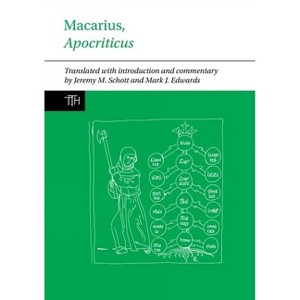
Macarius, Apocriticus - (Translated Texts for Historians) (Paperback) - 1 of 1

Macarius, Apocriticus - (Translated Texts for Historians) (Paperback)

$43.50

In Stock

Free & easy returns

Free & easy returns

Return this item by mail or in store within 90 days for a full refund.
Eligible for registries and wish lists

About this item

Highlights

  • The Apocriticus purports to be the record of a four-day public debate between a pagan philosopher, whom the text calls simply the "Hellene," and the author, Macarius, a Christian rhetor.
  • About the Author: Jeremy M. Schott is Associate Professor in the Department of Religious Studies at Indiana University, Bloomington.
  • 384 Pages
  • Religion + Beliefs, Christianity
  • Series Name: Translated Texts for Historians

Description


About the Book


A new English translation of The Apocriticus of Macarius, with notes and introductory essays. This important text purports to be the record of a debate between a pagan philosopher, and Macarius, a Christian rhetor, and is a rich, but neglected, source for the history of intellectual and cultural conflict between Christian and Hellene intellectuals.


Book Synopsis


The Apocriticus purports to be the record of a four-day public debate between a pagan philosopher, whom the text calls simply the "Hellene," and the author, Macarius, a Christian rhetor. The text is a rich, though often neglected, source for the history of intellectual and cultural conflict between Christian and Hellene intellectuals in the fourth century CE.

While the Apocriticus has frequently attracted the attention of scholars as a possible source of fragments from Porphyry's Against the Christians, the text as a whole is significant in its own right. Macarius defends the allegorical reading of scripture and presents interesting discussions concerning ascetic practice and the cult of the martyrs.

The philosophical and theological eclecticism of the text should also be of interests to scholars of early Christianity and later ancient philosophy. The fictitious dialogue weaves together philosophical and theological arguments, often in a "popularized" form. The text thus represents an interesting contrast to more formal "high" philosophical and theological texts of the period.

As well as a new English translation of an important text, this volume includes notes and introductory essays setting the work in its historical and intellectual contexts.


Review Quotes


'Such use of this affordable book is undoubtedly illuminating and enjoyable and will lead to the widespread distribution of this extensive ancient text, especially since the English-speaking readership far outnumber those of the readers who are fluent in Greek, French and / or German.'
Ulrich Volp, Zeitschift für antikes Christentum (Translated from German)


'This affordable book is undoubtedly enlightening and enjoyable, and will lead to widespread use of this vast ancient text.' (Translated from German) Ulrich Volp, Zeitschrift für Antikes Christentum


About the Author


Jeremy M. Schott is Associate Professor in the Department of Religious Studies at Indiana University, Bloomington. His previous publications include Eusebius of Caesarea: Tradition and Innovation (with Aaron Johnson, 2013) and Christianity, Empire and the Making of Religion in Late Antiquity (2008).

Professor Mark J. Edwards is Tutor in Theology at Christ Church College, Oxford. His previous publications include Catholicity and Heresy in the Early Church (2009), Image, Word and God in the Early Christian Centuries (2012) and Christians, Gnostics and Philosophers in Late Antiquity (2012).

Dimensions (Overall): 8.2 Inches (H) x 5.7 Inches (W) x .7 Inches (D)
Weight: .9 Pounds
Suggested Age: 22 Years and Up
Number of Pages: 384
Genre: Religion + Beliefs
Sub-Genre: Christianity
Series Title: Translated Texts for Historians
Publisher: Liverpool University Press
Theme: History
Format: Paperback
Language: English
Street Date: March 23, 2015
TCIN: 1011334754
UPC: 9781781381304
Item Number (DPCI): 247-13-1478
Origin: Made in the USA or Imported
If the item details aren’t accurate or complete, we want to know about it.

Shipping details

Estimated ship dimensions: 0.7 inches length x 5.7 inches width x 8.2 inches height
Estimated ship weight: 0.9 pounds
We regret that this item cannot be shipped to PO Boxes.
This item cannot be shipped to the following locations: American Samoa (see also separate entry under AS), Guam (see also separate entry under GU), Northern Mariana Islands, Puerto Rico (see also separate entry under PR), United States Minor Outlying Islands, Virgin Islands, U.S., APO/FPO, Alaska, Hawaii

Return details

This item can be returned to any Target store or Target.com.
This item must be returned within 90 days of the date it was purchased in store, delivered to the guest, delivered by a Shipt shopper, or picked up by the guest.
See the return policy for complete information.

Q: Who is the author of this translated text?

submitted by AI Shopping Assistant - 3 days ago
  • A: The author of the translation is Jeremy M. Schott, an Associate Professor at Indiana University.

    submitted byAI Shopping Assistant - 3 days ago
    Ai generated

Q: What type of debates does The Apocriticus document?

submitted by AI Shopping Assistant - 3 days ago
  • A: It documents a four-day public debate between a pagan philosopher and Macarius, a Christian rhetor.

    submitted byAI Shopping Assistant - 3 days ago
    Ai generated

Q: What is the significance of this text for scholars?

submitted by AI Shopping Assistant - 3 days ago
  • A: The text is significant for understanding early Christian thought and the philosophical debates of the time.

    submitted byAI Shopping Assistant - 3 days ago
    Ai generated

Q: What does Macarius defend in his arguments?

submitted by AI Shopping Assistant - 3 days ago
  • A: Macarius defends the allegorical reading of scripture and discusses ascetic practices and the cult of martyrs.

    submitted byAI Shopping Assistant - 3 days ago
    Ai generated

Q: What is the main theme of The Apocriticus?

submitted by AI Shopping Assistant - 3 days ago
  • A: The main theme revolves around the intellectual and cultural conflict between Christian and pagan philosophies during the fourth century CE.

    submitted byAI Shopping Assistant - 3 days ago
    Ai generated

Additional product information and recommendations

Discover more options
Trending Religion

Get top deals, latest trends, and more.

Privacy policy