Target New ArrivalsGift Ideas for MomClothing, Shoes & AccessoriesHome & DecorKitchen & DiningOutdoor Living & GardenGroceryHousehold EssentialsBabyBeautyPersonal CareHealthWellnessLuggageSports & OutdoorsToysElectronicsVideo GamesMovies, Music & BooksSchool & Office SuppliesParty SuppliesGift IdeasGift CardsPetsUlta Beauty at TargetShop by CommunityTarget OpticalDealsClearanceTarget New ArrivalsSpring OutfitsGift Ideas for MomWomen’s Festival OutfitsTop DealsTarget Circle DealsWeekly AdShop Order PickupShop Same Day DeliveryRegistryRedCardTarget CircleFind Stores
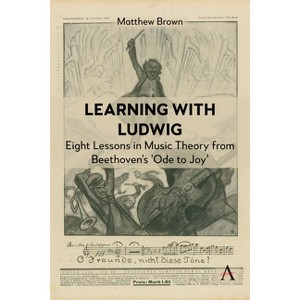
Learning with Ludwig - by  Matthew Brown (Paperback) - 1 of 1

Learning with Ludwig - by Matthew Brown (Paperback)

$24.95

Pre-order

Free & easy returns

Free & easy returns

Return this item by mail or in store within 90 days for a full refund.
Eligible for registries and wish lists

About this item

Highlights

  • Explores how Beethoven's iconic "Ode to Joy" theme and the finale of his Ninth Symphony encapsulate a masterclass in tonal composition, grounded in his rigorous training and deep theoretical knowledge.
  • About the Author: Born in London, Matthew Brown is a British American musicologist who specializes in tonal theory and the music of Claude Debussy.
  • 100 Pages
  • Music, History & Criticism

Description


About the Book


Beethoven's Freude theme--or "Ode to Joy"--is perhaps the most iconic melody ever created. This book sets out to show why the Freude theme has acquired this almost mythic status and what its use in the finale of the Ninth Symphony reveals about the mechanics of tonal composition.


Book Synopsis


Explores how Beethoven's iconic "Ode to Joy" theme and the finale of his Ninth Symphony encapsulate a masterclass in tonal composition, grounded in his rigorous training and deep theoretical knowledge.

First performed two hundred years ago on May 7, 1824, at Vienna's Kärnthnerthor Theater, Beethoven's Freude theme--or "Ode to Joy"--is perhaps the most iconic melody ever created. This book sets out to show why the Freude theme has acquired this almost mythic status and what its use in the finale of the Ninth Symphony reveals about the mechanics of tonal composition. In particular, the book explains how the finale of the Ninth Symphony offers a crash course in music theory. That course covers everything from the basics of tonal voice leading and motivic development to advanced topics such as double counterpoint, canon, and ars combinatoria. Beethoven had good reason to do so: by 1824, he had not only spent the past fifty years listening, performing, and creating music, but he had also spent much of that time studying and teaching music theory. Having received early lessons from his father, Beethoven studied with Christian Gottlob Neefe during the 1780s, Joseph Haydn, Johann Georg Albrechtsberger, and others in the early to mid 1790s, and Antonio Salieri in the 1790s and early 1800s. Moreover, Beethoven not only taught a large number of students, such as Carl Czerny, Ferdinand Ries, Anton Schindler, Archduke Rudolph, Baroness Dorothea von Ertmann, Maria von Elverfeldt, and Countess Therese Brunsvik, but he also assembled an extensive library of theory treatises, including those by J. J. Fux, Johann Mattheson, C. P. E. Bach, Johann Philipp Kirnberger, Friedrich Marpurg, Joseph Riepel, Daniel Gottlob Türk, Heinrich Koch, to name but a few. To highlight Beethoven's love of music theory, this book is arranged as a series of eight lessons. The lessons support two simple claims: 1) melody is the most important component of tonal music; and 2) improvisation plays a vital role in learning how music is composed. They begin by examining the structure and genesis of the Freude theme. Next, they show how the theme is treated as a cantus firmus in Part 1 of the finale and how it is written for contrapuntal purposes in Part 2. Finally, the last two lessons focus on the role played in Beethoven's conception of the finale: the penultimate lesson discusses the two vocal cadenzas that appear near the end of Part 2, and the last lesson shows how the overall form of the finale was inspired by that of improvised keyboard fantasies.


About the Author


Born in London, Matthew Brown is a British American musicologist who specializes in tonal theory and the music of Claude Debussy. He is currently Professor of Music Theory at the Eastman School of Music in Rochester, NY.

Dimensions (Overall): 9.0 Inches (H) x 6.0 Inches (W) x .5 Inches (D)
Weight: 1.0 Pounds
Suggested Age: 22 Years and Up
Number of Pages: 100
Genre: Music
Sub-Genre: History & Criticism
Publisher: Anthem Press
Format: Paperback
Author: Matthew Brown
Language: English
Street Date: September 8, 2026
TCIN: 1005224128
UPC: 9781839997884
Item Number (DPCI): 247-07-5118
Origin: Made in the USA or Imported
If the item details aren’t accurate or complete, we want to know about it.

Shipping details

Estimated ship dimensions: 0.5 inches length x 6 inches width x 9 inches height
Estimated ship weight: 1 pounds
We regret that this item cannot be shipped to PO Boxes.
This item cannot be shipped to the following locations: American Samoa (see also separate entry under AS), Guam (see also separate entry under GU), Northern Mariana Islands, Puerto Rico (see also separate entry under PR), United States Minor Outlying Islands, Virgin Islands, U.S., APO/FPO, Alaska, Hawaii

Return details

This item can be returned to any Target store or Target.com.
This item must be returned within 90 days of the date it was purchased in store, delivered to the guest, delivered by a Shipt shopper, or picked up by the guest.
See the return policy for complete information.

Q: What are the main themes discussed in the book?

submitted by AI Shopping Assistant - 1 month ago
  • A: The book discusses the 'Ode to Joy' theme and its role in tonal composition, highlighting Beethoven's mastery in music theory.

    submitted byAI Shopping Assistant - 1 month ago
    Ai generated

Q: What is the significance of the 'Ode to Joy' theme?

submitted by AI Shopping Assistant - 1 month ago
  • A: The 'Ode to Joy' theme is examined for its legendary status and its function within the finale of the Ninth Symphony.

    submitted byAI Shopping Assistant - 1 month ago
    Ai generated

Q: Who is the author, and what is his expertise?

submitted by AI Shopping Assistant - 1 month ago
  • A: The author, Matthew Brown, is a musicologist specializing in tonal theory and the works of Claude Debussy.

    submitted byAI Shopping Assistant - 1 month ago
    Ai generated

Q: How does the book structure its lessons on music theory?

submitted by AI Shopping Assistant - 1 month ago
  • A: The book is structured into eight lessons that explore melody, improvisation, and the analysis of Beethoven's Ninth Symphony finale.

    submitted byAI Shopping Assistant - 1 month ago
    Ai generated

Q: What aspects of Beethoven's training are covered?

submitted by AI Shopping Assistant - 1 month ago
  • A: It covers Beethoven's early training, his studies with various composers, and his approach to teaching music theory.

    submitted byAI Shopping Assistant - 1 month ago
    Ai generated

Additional product information and recommendations

Discover more options

Trending Music & Performing Arts

Get top deals, latest trends, and more.

Privacy policy