Sponsored
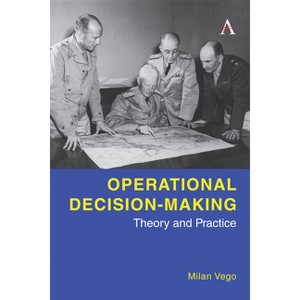
Operational Decision-Making - by Milan Vego (Hardcover)
Pre-order
Sponsored
About this item
Highlights
- Explains how operational-level commanders must make complex, forward-looking decisions based on incomplete information, treating their choices as hypotheses shaped by uncertainty and large-scale military dynamics.
- About the Author: Dr. Milan Vego is Professor of Operations, Joint Military Operations (JMO) Department, U.S. Naval War College, Newport, RI, USA.
- 260 Pages
- Technology, History
Description
About the Book
The highest art of operational leadership is that of making timely and sound decisions. The act of exercising command consists of making decisions and ordering their execution.
Book Synopsis
Explains how operational-level commanders must make complex, forward-looking decisions based on incomplete information, treating their choices as hypotheses shaped by uncertainty and large-scale military dynamics.
The number and importance of the decisions vary for each level of war. The higher the level of war, the fewer decisions are made and the larger the time window for making them. Operational commanders make fewer decisions, but the impact of these decisions is much greater than those made at the tactical level. The key for making sound operational decisions is to have an accurate picture of the operational situation. Such a picture cannot be obtained by a simple sum of tactical data or information. In fact, the operational situation should be built as a synthesis of strategic and tactical information pertaining to the operational commander's area of responsibility plus his area of interest. It deals with both military and nonmilitary aspects of the situation. This is especially true for the operational commander and, to a lesser extent, for subordinate tactical commanders. The operational commander must make his decisions by considering trends in the operational situation several weeks or even months into the future. In contrast, the tactical commander is concerned with the developments of the tactical situation, from a few hours to 72 or 96 hours in the future. Information technologies should be considered as aids in making operational decisions, not as the masters of the entire decision-making process. The personality traits, professional education, experience, judgment, and wisdom of the operational commander are the key to making sound operational or strategic decisions.
Combat decision is an arbitrary term for the decisions made by any command echelon that directly or indirectly deals with the employment of one's combat forces across the spectrum of conflict. In terms of their consequences for the situation in a theater, strategic, tactical, and operational combat decisions are differentiated. Operational decisions are made by operational or operational-tactical commanders. They are intended to have a major effect on a campaign or major operation during its planning, preparation, and execution phases. The commander's most important operational decisions pertain to changes in the original objectives, shift from offensive to defensive, shift of the sector of main effort or point of main attack (defense), concentration or counter concentration, maneuver or counter maneuver, use or non-use of tactical or operational fires, change in sequencing and synchronization, shift in phases, ordering of operational pause, commitment of operational reserves, pursuit or counter pursuit, and consolidation of operational/strategic success. Other operational decisions are aimed at changing, altering, modifying, or rescinding decisions made by subordinate commanders if their decisions and actions endanger the overall mission accomplishment. The operational decisions in the post-hostilities phase of a campaign are relatively few but are also critical for consolidating the strategic success achieved during the major combat phase. They include a decision to disarm the enemy's large forces, arrest and take into custody the leading members of the defeated enemy, redeploy friendly forces to another part of the respective theatre, bring in fresh friendly forces to fight an insurgency, or plan and execute deception.
The main method in making a decision is by using an estimate of a military situation. In military terms, the commander's estimate of the situation is understood as a logical process of reasoning by which a commander considers all the factors affecting a military situation to determine a course of action to accomplish a given mission. The estimate is a reasoned solution to a problem in which each step in the process incrementally leads to a decision that, without these steps, could be arrived at only by an accident. In the estimate, the commander assesses the situation and then tries to embark on a certain course of action aimed at changing the situation for the better or at least taking advantage of the given situation. The ultimate result of the estimate should be a sound decision. The estimate of the situation makes the chances of reaching a sound decision much higher than if an ad hoc method is used. One of the prerequisites for making a quick decision is to grasp the essential points of a given situation quickly and then evaluate them properly. It is in this determination that one's reasoning and imaginative faculties come into play. In conducting the estimate of the situation, the commander should focus his mental efforts on the most important things. The facts of the situation should be clearly differentiated from assumptions or speculation. All the facts should have a proof. The commander should remain calm. He should think quickly but should not act in haste. He should rethink the situation and make the decision independently while receiving reports from his subordinates. The commander should express his decision in short, clear sentences. The estimate of the situation should not be conducted for the purpose of justifying a decision made beforehand.
About the Author
Dr. Milan Vego is Professor of Operations, Joint Military Operations (JMO) Department, U.S. Naval War College, Newport, RI, USA.
Shipping details
Return details
Frequently bought together





Trending Book Pre-Orders