Sponsored
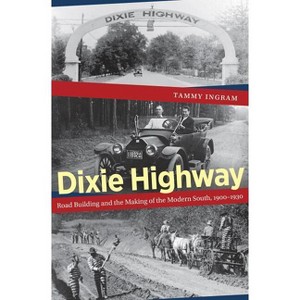
Dixie Highway - by Tammy Ingram (Paperback)
In Stock
Sponsored
About this item
Highlights
- At the turn of the twentieth century, good highways eluded most Americans and nearly all southerners.
- Author(s): Tammy Ingram
- 272 Pages
- History, United States
Description
About the Book
Dixie Highway: Road Building and the Making of the Modern South, 1900-1930
Book Synopsis
At the turn of the twentieth century, good highways eluded most Americans and nearly all southerners. In their place, a jumble of dirt roads covered the region like a bed of briars. Introduced in 1915, the Dixie Highway changed all that by merging hundreds of short roads into dual interstate routes that looped from Michigan to Miami and back. In connecting the North and the South, the Dixie Highway helped end regional isolation and served as a model for future interstates. In this book, Tammy Ingram offers the first comprehensive study of the nation's earliest attempt to build a highway network, revealing how the modern U.S. transportation system evolved out of the hard-fought political, economic, and cultural contests that surrounded the Dixie's creation.
The most visible success of the Progressive Era Good Roads Movement, the Dixie Highway also became its biggest casualty. It sparked a national dialogue about the power of federal and state agencies, the role of local government, and the influence of ordinary citizens. In the South, it caused a backlash against highway bureaucracy that stymied road building for decades. Yet Ingram shows that after the Dixie Highway, the region was never the same.
Review Quotes
"[This] well-written and accessible account of the Dixie Highway [shows that] road building is so much more than dirt and engineering." -- Register of the Kentucky Historical Society
"A solid and well-written discussion of the myriad aspects of road building in the Progressive-Era South." -- H-SHGAPE
"Although historians have previously examined the Good Roads Movement, scholars of the early twentieth-century South have long awaited a fully contextualized study of road building. Dixie Highway provides the most comprehensive study that we have today of the Good Roads Movement and its consequences. This will be essential reading for students of the modern South." -- William A. Link, author of Atlanta, Cradle of the New South: Race and Remembering in the Civil War's Aftermath
"By skillfully combining national, regional, and state perspectives, Ingram offers a refreshing, informative, and a welcome addition to transportation history." -- Journal of American History
"Complex and fascinating. From accurate highway signage to the emergence of maps, she shows how people imagined, financed, and built roads in the American South. In her hands, the story of infrastructure development weaves in and out of stories of southern politics, race relations, and economic development, clearly showing, as she says, that 'road building was a crucial linchpin in the transition to the modern South.'" -- Journal of Southern History
"Ingram provides a template for future work in this area that others would do well to follow, and that students will benefit from in a variety of courses. A welcome addition to the literature on transportation in the U.S. Recommended. All levels/libraries." -- CHOICE
"Ingram provides an interesting discussion of the impact of World War I on roads, a topic often lacking in highway histories." -- AAG Review of Books
"Its examples are telling and illustrate effectively the complicated history of federally funded and managed Southern highway construction, raising issues that remain relevant in current debates on funding highway repair. Recommended for all readers interested in American politics and transportation." -- Library Journal