Sponsored
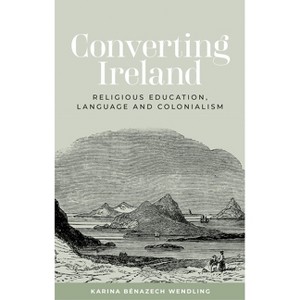
Converting Ireland - by Karina Bénazech Wendling Hardcover
Pre-order
Sponsored
About this item
Highlights
- Karina Bénazech Wendling offers a re-assessment of 'souperism'--the long-debated claim that food was used to convert Irish Catholics to Protestantism during the Great Famine.
- About the Author: Karina Bénazech Wendling is a Senior Lecturer at the University of Lorraine
- 344 Pages
- History, Europe
Description
About the Book
Karina Bénazech Wendling offers a re-assessment of 'souperism' and of British cultural imperialism by focusing on the use of the Irish language and the Irish Bible in schools. Her book explores Protestant societies' role in Ireland's religious and political landscape, the rise of Catholic counter-missions, and nationalist resistance. It offers new insights into Irish and global religious history.
Book Synopsis
Karina Bénazech Wendling offers a re-assessment of 'souperism'--the long-debated claim that food was used to convert Irish Catholics to Protestantism during the Great Famine. Focusing on the Irish Society for Promoting the Education of the Native Irish through their Own Language, the first group labeled 'soupers' in 1841, she uncovers a more complex picture. Rather than a mere tool of British cultural imperialism, the Society had a deep engagement with the Irish language and Bible translation, while also encouraging religious conversions in the West. The book explores the Society's role in Ireland's religious and political landscape, the rise of Catholic counter-missions, and nationalist resistance. Offering fresh insights into Ireland's religious history and global missionary movements, this book is essential for scholars of Irish studies, interdenominational relations, and education in Ireland.
From the Back Cover
Accounts of 'souperism' - the alleged use of food to induce Irish Catholics to convert to Protestantism - have long featured in the popular memory of the Great Famine (1845-50). Scholars have cast a more critical eye over the phenomenon and its origins in the 'Second Reformation' of the 1820s and the 'Bible War' that followed in the 1830s and 1840s.
With this book, Karina Bénazech Wendling makes an important contribution to that literature through her focus on the first body against which the term 'souper' was popularised in 1841 - the Irish Society for Promoting the Education of the Native Irish through the Medium of their Own Language. Formed in Dublin in 1818, it remained an independent body in Ireland until its merger with the Irish Church Mission in 1853.
The book makes a persuasive case that the Irish Society was a complex religious, cultural and political phenomenon that deserves to be re-evaluated rather than reductively dismissed as a tool of British cultural imperialism or sectarian anti-Catholicism. Beyond converting Ireland, its founders took a serious interest in the Irish language and the Irish Bible. And so did their pupils as many converted in the West. The book explores the links between the campaigns of 'ostracism', the establishment of 'refuge-colonies' for converts and the deployment of Catholic counter-missions with the support of nationalist leaders and of Paul Cullen.
This book has much to offer the scholar not only of Ireland's fraught religious and educational history, but also of the global history of missions and interdenominational relations.
About the Author
Karina Bénazech Wendling is a Senior Lecturer at the University of Lorraine
Shipping details
Return details
Frequently bought together





Trending Non-Fiction






Discover more options