Sponsored
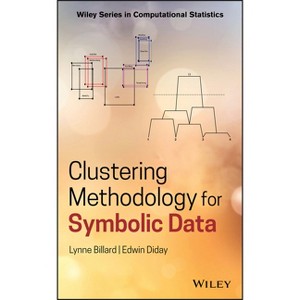
Clustering Methodology for Symbolic Data - Wiley Computational Statistics by Lynne Billard & Edwin Diday Hardcover
In Stock
Sponsored
About this item
Highlights
- Covers everything readers need to know about clustering methodology for symbolic data--including new methods and headings--while providing a focus on multi-valued list data, interval data and histogram data This book presents all of the latest developments in the field of clustering methodology for symbolic data--paying special attention to the classification methodology for multi-valued list, interval-valued and histogram-valued data methodology, along with numerous worked examples.
- About the Author: LYNNE BILLARD, PHD, is University Professor in the Department of Statistics at the University of Georgia, USA.
- 352 Pages
- Mathematics, Probability & Statistics
- Series Name: Wiley Computational Statistics
Description
Book Synopsis
Covers everything readers need to know about clustering methodology for symbolic data--including new methods and headings--while providing a focus on multi-valued list data, interval data and histogram data
This book presents all of the latest developments in the field of clustering methodology for symbolic data--paying special attention to the classification methodology for multi-valued list, interval-valued and histogram-valued data methodology, along with numerous worked examples. The book also offers an expansive discussion of data management techniques showing how to manage the large complex dataset into more manageable datasets ready for analyses.
Filled with examples, tables, figures, and case studies, Clustering Methodology for Symbolic Data begins by offering chapters on data management, distance measures, general clustering techniques, partitioning, divisive clustering, and agglomerative and pyramid clustering.
- Provides new classification methodologies for histogram valued data reaching across many fields in data science
- Demonstrates how to manage a large complex dataset into manageable datasets ready for analysis
- Features very large contemporary datasets such as multi-valued list data, interval-valued data, and histogram-valued data
- Considers classification models by dynamical clustering
- Features a supporting website hosting relevant data sets
Clustering Methodology for Symbolic Data will appeal to practitioners of symbolic data analysis, such as statisticians and economists within the public sectors. It will also be of interest to postgraduate students of, and researchers within, web mining, text mining and bioengineering.
From the Back Cover
Covers everything readers need to know about clustering methodology for symbolic data--including new methods and headings--while providing a focus on multi-valued list data, interval data and histogram data
This book presents all of the latest developments in the field of clustering methodology for symbolic data--paying special attention to the classification methodology for multi-valued list, interval-valued and histogram-valued data methodology, along with numerous worked examples. The book also offers an expansive discussion of data management techniques showing how to manage the large complex dataset into more manageable datasets ready for analyses.
Filled with examples, tables, figures, and case studies, Clustering Methodology for Symbolic Data begins by offering chapters on data management, distance measures, general clustering techniques, partitioning, divisive clustering, and agglomerative and pyramid clustering.
Clustering Methodology for Symbolic Data:
- Provides new classification methodologies for histogram valued data reaching across many fields in data science
- Demonstrates how to manage a large complex dataset into manageable datasets ready for analysis
- Features very large contemporary datasets such as multi-valued list data, interval-valued data, and histogram-valued data
- Considers classification models by dynamical clustering
- Features a supporting website hosting relevant data sets
Clustering Methodology for Symbolic Data will appeal to practitioners of symbolic data analysis, such as statisticians and economists within the public sectors. It will also be of interest to postgraduate students of, and researchers within, web mining, text mining and bioengineering.
About the Author
LYNNE BILLARD, PHD, is University Professor in the Department of Statistics at the University of Georgia, USA. She has over two hundred and twenty-five publications mostly in leading journals, and co-edited six books. Professor Billard is a former president of ASA, IBS, and ENAR.
EDWIN DIDAY, PHD, is the Professor of Computer Science at Centre De Recherche en Mathematiques de la Decision, CEREMADE, Université Paris-Dauphine, Université PSL, Paris, France. He has published fifty-eight papers and authored or edited fourteen books. Professor Diday is also the founder of the Symbolic Data Analysis field.
Shipping details
Return details
Trending Non-Fiction