Sponsored
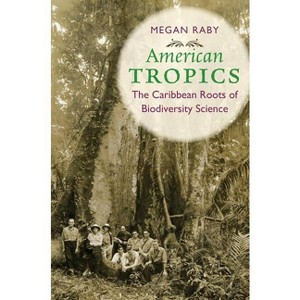
American Tropics - Flows, Migrations, and Exchanges by Megan Raby Paperback
In Stock
Sponsored
About this item
Highlights
- Biodiversity has been a key concept in international conservation since the 1980s, yet historians have paid little attention to its origins.
- Author(s): Megan Raby
- 336 Pages
- Nature, Ecology
- Series Name: Flows, Migrations, and Exchanges
Description
About the Book
"By examining U.S. biological fieldwork from the era of the Spanish-American War and the construction of the Panama Canal through the anticolonial movements of the 1960s and 1970s, Raby demonstrates how research in tropical biology developed in tandem with the southward expansion of U.S. empire and argues that both the key scientific concepts and the values embedded in the modern biodiversity discourse were developed in significant part through U.S. biologists' encounters with the Caribbean. In doing so, Raby brings to the forefront a ... neglected history of twentieth-century U.S. science and empire. While historians of science and environment have shown interest in the application of U.S. ecological and environmental ideas in the tropical world, this study demonstrates how that knowledge also flowed in the other direction"--
Book Synopsis
Biodiversity has been a key concept in international conservation since the 1980s, yet historians have paid little attention to its origins. Uncovering its roots in tropical fieldwork and the southward expansion of U.S. empire at the turn of the twentieth century, Megan Raby details how ecologists took advantage of growing U.S. landholdings in the circum-Caribbean by establishing permanent field stations for long-term, basic tropical research. From these outposts of U.S. science, a growing community of American "tropical biologists" developed both the key scientific concepts and the values embedded in the modern discourse of biodiversity.
Considering U.S. biological fieldwork from the era of the Spanish-American War through the anticolonial movements of the 1960s and 1970s, this study combines the history of science, environmental history, and the history of U.S.-Caribbean and Latin American relations. In doing so, Raby sheds new light on the origins of contemporary scientific and environmentalist thought and brings to the forefront a surprisingly neglected history of twentieth-century U.S. science and empire.
Review Quotes
"American Tropics is not only the best book we have on the scientific reinvention of 'the tropics' across the twentieth century, but it is also a tour de force demonstration of how the ideal of biodiversity emerged from place-based field practices. This is a history that matters to the future of tropical science and conservation."--Paul Sutter, University of Colorado Boulder
"A remarkably persuasive genealogy of ideas. . . . An important contribution to our understanding of science in the Caribbean, and of the way supposedly universal knowledge is always a local hybrid."--Brill Journals
"Raby's study contributes a crucial and expansive narrative of biological connections and a politically informed evolution of ideas. Like the best histories, her work opens avenues for further research on an important and timely subject."--Environmental History
"Skillfully shows the strategic and serendipitous ways field science coincided with political and economic imperial pursuits in the twentieth century. This enlarged context greatly expands how we can look at both the process and knowledge of science as products of social contingencies."--Edge Effects
"The first book to situate the rise of the scientific concept of biodiversity within its larger circum-Caribbean context, American Tropics is a sophisticated and compelling journey through the research practices at field stations outside the U.S. mainland in Cuba, Jamaica, Guyana, and Panama. Using these stations as launching points, Raby skillfully shows the strategic and serendipitous ways these encounters mapped onto political and economic imperial pursuits. Such insights will echo through our understandings of tropical life as a resource for generations to come."--Emily Wakild, author of Revolutionary Parks
"This book is eminently recommendable. Raby has given us needed insight into the history of tropical American science within the context of imperial expansion and the construction of Caribbean hegemony."--H-Net Reviews
"Thorough and ground-breaking. . . . Raby marshals a breathtaking amount of evidence."--American Historical Review
Shipping details
Return details
Trending Non-Fiction






Discover more options