Sponsored
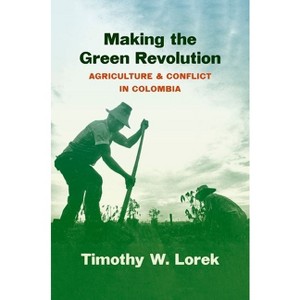
Making the Green Revolution - Flows, Migrations, and Exchanges by Timothy W Lorek Paperback
In Stock
Sponsored
About this item
Highlights
- In November 2017, the International Center for Tropical Agriculture (CIAT) celebrated its fiftieth anniversary at its headquarters outside Palmira, Colombia.
- Author(s): Timothy W Lorek
- 342 Pages
- Science, Environmental Science
- Series Name: Flows, Migrations, and Exchanges
Description
About the Book
"In November 2017, the International Center for Tropical Agriculture (CIAT) celebrated its fiftieth anniversary at its headquarters outside Palmira, Colombia. As an important research center of the so-called Green Revolution in agricultural science and technologies, CIAT emphasizes its contributions to sustainability, food security, gender equity, inclusive markets, and resilient, climate-smart agriculture. Yet these terms hardly describe the Cauca Valley where CIAT is physically located, a place that has been transformed into an industrial monoculture of sugarcane where thirteen Colombian corporations oversee the vast majority of this valley's famously fertile soil. This exemplifies the paradox Timothy W. Lorek describes: an international research center emphasizing small-scale and sustainable agricultural systems sited conspicuously on a landscape otherwise dominated by a large-scale corporate sugarcane industry"--
Book Synopsis
In November 2017, the International Center for Tropical Agriculture (CIAT) celebrated its fiftieth anniversary at its headquarters outside Palmira, Colombia. As an important research center of the so-called Green Revolution in agricultural science and technologies, CIAT emphasizes its contributions to sustainability, food security, gender equity, inclusive markets, and resilient, climate-smart agriculture. Yet these terms hardly describe the Cauca Valley where CIAT is physically located, a place that has been transformed into an industrial monoculture of sugarcane where thirteen Colombian corporations oversee the vast majority of this valley's famously fertile soil. This exemplifies the paradox Timothy W. Lorek describes in Making the Green Revolution: an international research center emphasizing small-scale and sustainable agricultural systems sited conspicuously on a landscape otherwise dominated by a large-scale corporate sugarcane industry.
Utilizing archives in Colombia, Puerto Rico, and the United States, Lorek tracks the paradoxical but intertwined twentieth-century processes that produced both CIAT and sugar in the Cauca Valley. This history reveals how Colombians contributed to the rise of a global Green Revolution and how that international process in turn intersected with a complex and long-running rural conflict in Colombia.
Review Quotes
"Making the Green Revolution fill[s] a void in the histories of international agricultural science programs. . . . Lorek's work cohesively binds together the agricultural history of the Cauca Valley, the experiences of the Latin American Cold War with that of the multigeneration Colombia armed conflict. . . . [F]or a historian of science and agriculture of the post-World War II decades, Lorek's narrative is crucial for gaining an understanding of yet another country's experience of agricultural transformation amidst violence and social disparity."--Isis
"Lorek's work fills a notable gap in the history of [international exchanges of agricultural expertise between the USA, Puerto Rico, Mexico and Colombia]. . . . Making the Green Revolution is well written and engaging to read and will be of interest to anyone concerned with the political economy of agricultural science, the history of the Green Revolution, and transnational exchanges of scientific expertise more widely."--Agriculture and Human Values
"Masterful. . . . A readable book with a clear organization, Making the Green Revolution is a mandatory stop for anyone interested in Latin America, Colombia, and the Global South's entangled encounters with empire-making projects and processes."--H-LatAm
"This innovative and persuasive book reveals the deep history of Latin American innovation and experimentation in agricultural science that preceded U.S. Cold War interventions by many decades, arguing for the vital importance of Colombia and Colombian actors and institutions to the global campaign of agricultural transformation that later became known as the Green Revolution."--Tore Olsson, author of Agrarian Crossings: Reformers and the Remaking of the U.S. and Mexican Countryside
"Where Making the Green Revolution shines is the rich narrative that connects local and global histories of agricultural modernization and how it ties this story to the social and biological transformation of an agricultural landscape. Scholars interested in agrarian history, state formation, discourses of modernization and the Green Revolution will find it both illuminating and absorbing."--British Journal for the History of Science
Shipping details
Return details
Trending Non-Fiction





Discover more options