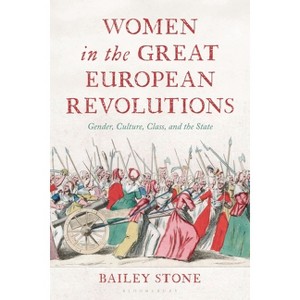
This book explores and compares the roles, mentalities, and destinies of elitist and working-class women in Europe's most dramatic revolutions: England's "Puritan Revolution" of 1640-1660, France's 1789 Revolution, and Russia's 1917 Revolution.
About the Author: Bailey Stone is an Emeritus Professor of European History and International Affairs and taught primarily at the University of Houston.
328 Pages
Social Science, Gender Studies
Description
About the Book
This book presents a comprehensive account of how queens, bourgeois women, and "ordinary" female laborers, and peasants reacted
Book Synopsis
This book explores and compares the roles, mentalities, and destinies of elitist and working-class women in Europe's most dramatic revolutions: England's "Puritan Revolution" of 1640-1660, France's 1789 Revolution, and Russia's 1917 Revolution. By providing one of the most detailed analyses to date of how feminist historians, sociologists, and specialists theorize gender, sexuality, and patriarchy the author draws connections to current debate over the causation of sociopolitical revolutions. This book briefly outlines the stage-by-stage progression of events in the English, French, and Russian Revolutions.
This book reappraises the relative importance ascribable to gendered and cultural factors through the disastrous revolutionary careers of three consort queens: i.e., Henrietta Maria of England, Marie-Antoinette of France, and Alexandra Feodorovna of Russia. Their political failings are contrasted with the political acumen of three earlier regnant queens: Elizabeth I, Cathérine de Médicis, and Catherine II ("the Great.")
This book demonstrates how women of humble social station used these unheard-of revolutionary situations either to express their grievances and voice their social aspirations or, on the other hand, to reaffirm their long-held allegiance to traditional principles, customs, and religion. It concludes by discussing race/ethnicity and statism as challenging issues that need to be confronted in any current discussion of women's revolutionary experiences.
Review Quotes
Bailey Stone's meticulously researched book advances our understanding of the central role played by women in major European revolutions. Stone combines insights from feminism and revolutionary studies to show how, despite the centrality of women's agency to revolutionary movements and for all the hopes of gender emancipation via these movements, post-revolutionary states confined women within new patriarchal state structures. This is a powerful, if depressing, insight. It is also one that all students and scholars of revolutions should engage. George Lawson, Professor of International Relations, Australian National University
In this masterful, deeply researched study, Bailey Stone expertly dissects the role and status of women in the genesis, course, and outcome of three European revolutions that defined the modern era. Arguing that gender as a historical phenomenon is best examined through its intersectionality with class, nationality, politics, and war, the author shows how the breakdown of public order and state collapse created a space for rethinking and recreating gender and family relationships in opposition to established patriarchies, only for this space to be narrowed or closed once revolutionary regimes solidified or were replaced by others devoted to restoring order. As this major study--illuminating our past as well as our present--demonstrates beyond any doubt, all patriarchies have their fragilities, making progress towards equality a possibility, if not an inevitability. Thomas E. Kaiser, Professor of History Emeritus, University of Arkansas at Little Rock
In this much-needed work, Bailey Stone brings feminist theory into the mainstream history of the great revolutions. Examining queens and peasants, radicals and traditionalists, Stone shows how the patriarchal structure of European societies shaped revolutionary struggles and their outcomes. This is essential reading for fully understanding these crucial events. Jack A. Goldstone, Virginia E. and John T. Hazel, Jr., Chair Professor of Public Policy, George Mason University
About the Author
Bailey Stone is an Emeritus Professor of European History and International Affairs and taught primarily at the University of Houston. Currently, Bailey Stone works in the Five Colleges Associates Program at Amherst, MA, and has been a member of the Five Colleges International Relations Seminar at Amherst
Dimensions (Overall): 9.0 Inches (H) x 6.0 Inches (W) x .75 Inches (D)
Weight: 1.34 Pounds
Suggested Age: 22 Years and Up
Number of Pages: 328
Genre: Social Science
Sub-Genre: Gender Studies
Publisher: Bloomsbury Academic
Format: Hardcover
Author: Bailey Stone
Language: English
Street Date: October 30, 2025
TCIN: 1007916820
UPC: 9798765153239
Item Number (DPCI): 247-51-3930
Origin: Made in the USA or Imported
If the item details aren’t accurate or complete, we want to know about it.
Shipping details
Estimated ship dimensions: 0.75 inches length x 6 inches width x 9 inches height
Estimated ship weight: 1.34 pounds
We regret that this item cannot be shipped to PO Boxes.
This item cannot be shipped to the following locations: American Samoa (see also separate entry under AS), Guam (see also separate entry under GU), Northern Mariana Islands, Puerto Rico (see also separate entry under PR), United States Minor Outlying Islands, Virgin Islands, U.S., APO/FPO
Return details
This item can be returned to any Target store or Target.com.
This item must be returned within 90 days of the date it was purchased in store, shipped, delivered by a Shipt shopper, or made ready for pickup.