Sponsored
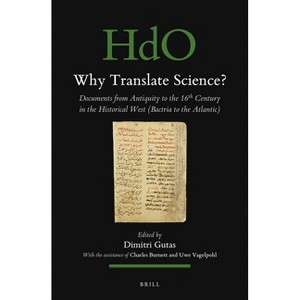
Why Translate Science? - Handbook of Oriental Studies: Section 1; The Near and Middle East by Dimitri Gutas Paperback
New at target
$89.00
Pre-order
Eligible for registries and wish lists
Sponsored
About this item
Highlights
- From antiquity to the 16th century, translation united culturally the peoples in the historical West (from Bactria to the shores of the Atlantic) and fueled the production and circulation of knowledge.
- About the Author: Dimitri Gutas, PhD.
- 774 Pages
- Philosophy, Eastern
- Series Name: Handbook of Oriental Studies: Section 1; The Near and Middle East
Description
About the Book
A collection of documents from antiquity to the 16th century in the historical West (Bactria to the Atlantic), in the original languages with an English translation and introductory essays, about the motivations and purposes of translation from and into Greek, Syriac, Middle Persian, Arabic, Hebrew, and Latin, as given in the personal statements by the translators, scholars, and historians of each society.
Book Synopsis
From antiquity to the 16th century, translation united culturally the peoples in the historical West (from Bactria to the shores of the Atlantic) and fueled the production and circulation of knowledge. The Hellenic scientific and philosophical curriculum was translated from and into, to mention the most prevalent languages, Greek, Syriac, Middle Persian, Arabic, Hebrew, and Latin.
To fill a lack in existing scholarship, this volume collects the documents that present the insider evidence provided in contemporary accounts of the motivations and purposes of translation given in the personal statements by the agents in this process, the translators, scholars, and historians of each society. Presented in the original languages with an English translation and introductory essays, these documents offer material for the study of the historical contextualization of the translations, the social history of science and philosophy in their interplay with traditional beliefs, and the cultural policies and ideological underpinnings of these societies.
Contributors
Michael Angold, Pieter Beullens, Charles Burnett, David Cohen, Gad Freudenthal, Dag Nikolaus Hasse, Anthony Kaldellis, Daniel King, Felix Mundt, Ignacio Sánchez, Isabel Toral, Uwe Vagelpohl, and Mohsen Zakeri.
Review Quotes
"The volume considers science in its broader historical sense, including medicine, astrology, and philosophy alongside mathematics and natural science, but excluding religious texts. Each contributed chapter provides an introductory essay contextualizing its sources within a specific historical period and culture. English translations of selected passages concerning the methodology of translation itself are rendered by chapter authors or from standard editions. Those same excerpts are also presented in the working translator's original language and script. Translations from and into Arabic, Greek, and Latin--and into Hebrew--receive the most attention, but Middle Persian and Syriac are also represented as target languages. Given its cost and focus, the volume will primarily be appropriate for institutions with robust history, philology, or philosophy programs, and will likely be of most use to advanced scholars in those disciplines."
P. M. Crowley, Choice Connect May 60.9 (2023).
About the Author
Dimitri Gutas, PhD. (1974), Yale University, is Professor Emeritus of Arabic at Yale. He has published on the medieval Graeco-Arabic translation movement, the transmission of Greek philosophical texts into Arabic (most recently Aristotle's Poetics, Brill, 2012), and Arabic philosophy (most recently, Avicenna and the Aristotelian Tradition, 2nd ed., Brill, 2014).
Charles Burnett, PhD. (1976), Cambridge University, is Professor of the History of Arabic/Islamic Influences in Europe at the Warburg Institute, University of London. His research centres on the transmission of texts from the Arab world to the West in the Middle Ages.
Uwe Vagelpohl, PhD. (2003), Cambridge University, is a research fellow at the Warburg Institute, University of London. His research centers on the reception of antique learning in the medieval Islamic world.
Contributors
Michael Angold, Pieter Beullens, Charles Burnett, David Cohen, Gad Freudenthal, Dag Nikolaus Hasse, Anthony Kaldellis, Daniel King, Felix Mundt, Ignacio Sánchez, Isabel Toral, Uwe Vagelpohl, and Mohsen Zakeri.
Dimensions (Overall): 9.25 Inches (H) x 6.1 Inches (W)
Suggested Age: 22 Years and Up
Number of Pages: 774
Genre: Philosophy
Sub-Genre: Eastern
Series Title: Handbook of Oriental Studies: Section 1; The Near and Middle East
Publisher: Brill
Format: Paperback
Author: Dimitri Gutas
Language: English
Street Date: April 16, 2026
TCIN: 1008684383
UPC: 9789004760899
Item Number (DPCI): 247-22-1955
Origin: Made in the USA or Imported
If the item details aren’t accurate or complete, we want to know about it.
Shipping details
Estimated ship dimensions: 1 inches length x 6.1 inches width x 9.25 inches height
Estimated ship weight: 1 pounds
We regret that this item cannot be shipped to PO Boxes.
This item cannot be shipped to the following locations: American Samoa (see also separate entry under AS), Guam (see also separate entry under GU), Northern Mariana Islands, Puerto Rico (see also separate entry under PR), United States Minor Outlying Islands, Virgin Islands, U.S., APO/FPO
Return details
This item can be returned to any Target store or Target.com.
This item must be returned within 90 days of the date it was purchased in store, shipped, delivered by a Shipt shopper, or made ready for pickup.
See the return policy for complete information.
Guests also viewed





Discover more options

$32.49 - $130.99
MSRP $32.00 - $130.00