Sponsored
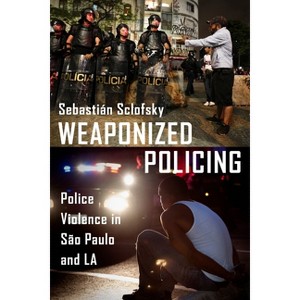
Weaponized Policing - by Sebastián Sclofsky
Pre-order
Sponsored
About this item
Highlights
- How police reproduce social, spatial, and racial inequalities in two global cities From Donald Trump to Brazil's Jair Bolsonaro, political leaders endorsing "law and order"--specifically through aggressive policing strategies-- have supported the formation of carceral states in self-proclaimed democracies.
- About the Author: Sebastián Sclofsky is Associate Professor of Criminal Justice at California State University, Stanislaus.
- 240 Pages
- Social Science, Criminology
Description
Book Synopsis
How police reproduce social, spatial, and racial inequalities in two global cities
From Donald Trump to Brazil's Jair Bolsonaro, political leaders endorsing "law and order"--specifically through aggressive policing strategies-- have supported the formation of carceral states in self-proclaimed democracies. In Weaponized Policing, Sebastián Sclofsky provides a comparative lens on this dynamic, taking a look at police-civilian violence in the United States and Brazil, and its impact on people's understanding of race, space, and citizenship.
The book argues that the socio-economic transformations of the last half-century, marked by the rise of neoliberal capitalism, have produced extreme levels of inequality, and created new forms of vulnerability that are managed and reproduced by police. The pacifying processes conducted by the police in their production and reproduction of social order produce the categories of black, poor, and periphery, transforming these subjects into the ultimate "other" against whom police intervention and violence is deemed necessary and justified for the sake of the city's well-being.
Drawing on hundreds of interviews with politicians, police officers, community activists, and low-income residents of São Paulo's periphery and neighborhoods in South L.A., Sclofsky follows the stories of individuals who live, and are policed, on the "peripheries." He argues that, in both countries, aggressive policing creates authoritarian enclaves within faulty democracies. As a result, residents of color are criminalized, individual rights are systematically violated, and a sense of second-class citizenship is developed--even when people live in a country where political rights are supposedly guaranteed, and free and fair elections do take place.
Review Quotes
"In an extensive analysis ranging from the local to the global, Sclofsky's focus on weaponized policing reveals the many ways in which the police power functions as a war power. The outcome is a major contribution to our understanding of the centrality of state violence in the reproduction of capitalist order."-- "Mark Neocleous, author of Pacification: Social War and the Power of Police."
"Sebastián Sclofsky prioritizes the voices and experiences of those on the receiving end of police power to demonstrate the transnational reality that policing actively produces racialized inequality through violence, humiliation, and regulation."-- "Alex S. Vitale, author of The End of Policing"
"The lives of residents in South L.A. and São Paulo's periphery are marked by terrifying and often dangerous encounters with the police. Based on extensive ethnographic research and hundreds of interviews in Brazil and the United States, Sclofsky's book takes us to neighborhoods turned into authoritarian enclaves, where heavily armed officers routinely use force against poor, Black, and Latino residents, where human rights are shoved aside in the name of security, and where security is understood as protection of the deeply unequal social order. A rare combination of theoretical verve, compassion, and commitment to justice, Weaponized Policing explains why and how police violence persists in democratic societies. It is also a decisive call for change."-- "Ieva Jusionyte, author of Exit Wounds: How America's Guns Fuel Violence Across the Border"
About the Author
Sebastián Sclofsky is Associate Professor of Criminal Justice at California State University, Stanislaus. He received his Ph.D. in Political Science from University of Florida in 2008.