Sponsored
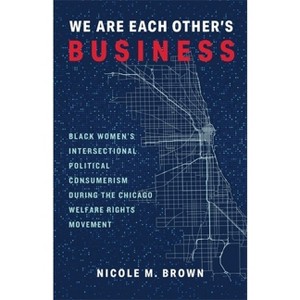
We Are Each Other's Business - by Nicole Marie Brown
In Stock
Sponsored
About this item
Highlights
- In the 1960s and 1970s, the Welfare Rights Movement organized at both local and national levels, advocating for poor people's inclusion, dignity, and autonomy.
- About the Author: Nicole M. Brown is an associate professor of sociology at Saint Mary's College of California.
- 240 Pages
- Social Science,
Description
About the Book
Nicole M. Brown examines Black women's leadership within the Chicago Welfare Rights Movement, calling for understanding them as sophisticated strategists who engaged the tensions among capitalism, consumerism, and economic liberation.
Book Synopsis
In the 1960s and 1970s, the Welfare Rights Movement organized at both local and national levels, advocating for poor people's inclusion, dignity, and autonomy. We Are Each Other's Business examines Black women's leadership within the Chicago Welfare Rights Movement, recasting their consumer activism as a form of Black feminist technology.
Nicole M. Brown calls for understanding the Black women of the Welfare Rights Movement as sophisticated strategists who engaged the tensions among capitalism, consumerism, and economic liberation. She analyzes Black women's engagement with consumer credit, tracing how they linked consumption with citizenship and critiqued the state's treatment of the poor. Brown offers a radical reframing of the struggle between Black women and the state as a battle of technologies, showing how Black women challenged "algorithmic assemblages of race, class, and gender" and "analog algorithms of poverty." She also shows how racism, sexism, and classism stifled opportunities for alliances: although the Welfare Rights Movement converged with consumer and women's rights movements, white and middle-class activists were unwilling to recognize poor Black women as fellow political actors. Bringing together historical sociology, computational methods, and intersectional Black feminist theory, We Are Each Other's Business offers innovative and generative insights into Black women's struggle for political and economic equity.
Review Quotes
We Are Each Other's Business recasts the struggle between Black women and the state during the Chicago Welfare Rights Movement as a "battle of technologies." It reveals how these women skillfully used consumerism as activism to challenge deep-seated state injustices against poor women, presenting an engaging narrative of resilience and resistance.--Traci Parker, author of Department Stores and the Black Freedom Movement: Workers, Consumers, and Civil Rights
Brown's ambitious and illuminating We Are Each Other's Business digs deep into the history of the welfare, women's, and consumer rights movements, demonstrating how poor Black women negotiated their status as citizens and consumers to create lasting social change in Chicago and beyond. The lessons she draws from the work of Temporary Woodlawn Organization, Jobs or Income Now, and the National Welfare Rights Organization are just as urgent today.--Virginia Eubanks, author of Automating Inequality: How High-Tech Tools Profile, Police, and Punish the Poor
About the Author
Nicole M. Brown is an associate professor of sociology at Saint Mary's College of California.
Shipping details
Return details
Frequently bought together



Trending Non-Fiction

Discover more options