Sponsored
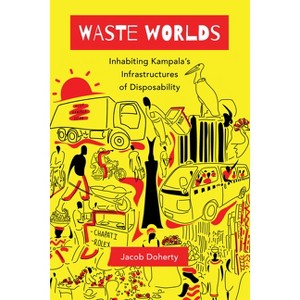
Waste Worlds - Atelier: Ethnographic Inquiry in the Twenty-First Century by Jacob Doherty Paperback
In Stock
Sponsored
About this item
Highlights
- Uganda's capital, Kampala, is undergoing dramatic urban transformations as its new technocratic government seeks to clean and green the city.
- About the Author: Jacob Doherty is Lecturer in Anthropology of Development at the University of Edinburgh.
- 288 Pages
- Social Science, Anthropology
- Series Name: Atelier: Ethnographic Inquiry in the Twenty-First Century
Description
About the Book
"Uganda's capital, Kampala, is undergoing dramatic urban transformations as its new technocratic government seeks to clean and green the city. Waste Worlds tracks the dynamics of development and disposability unfolding amid struggles over who and what belongs in the new Kampala. Garbage materializes these struggles. In the densely inhabited social infrastructures in and around the city's waste streams, people, places, and things become disposable but conditions of disposability are also challenged and undone. Drawing on years of ethnographic research, Jacob Doherty illustrates how waste makes worlds, offering the key intervention that disposability is best understood not existentially, as a condition of social exclusion, but infrastructurally, as a form of injurious social inclusion"--
Book Synopsis
Uganda's capital, Kampala, is undergoing dramatic urban transformations as its new technocratic government seeks to clean and green the city. Waste Worlds tracks the dynamics of development and disposability unfolding amid struggles over who and what belong in the new Kampala. Garbage materializes these struggles. In the densely inhabited social infrastructures in and around the city's waste streams, people, places, and things become disposable but conditions of disposability are also challenged and undone. Drawing on years of ethnographic research, Jacob Doherty illustrates how waste makes worlds, offering the key intervention that disposability is best understood not existentially, as a condition of social exclusion, but infrastructurally, as a form of injurious social inclusion.
From the Back Cover
"Waste Worlds is an ethically grounded, theoretically sophisticated, and politically astute book about how to write about waste in Africa without reducing Africans to waste, and about how to write about poverty on the second-largest continent without losing sight of the local, national, and global politics that shape that poverty. Jacob Doherty takes Kampala on its terms as a common city and analyzes the myriad ways ordinary Ugandans grapple with the waste worlds that make up their capital city. Waste, Doherty tells us in this powerful book, is not an object--it is something we do. We waste lives, we waste the environment, we waste things. And how we do all that is fundamentally political."--Jacob Dlamini, Assistant Professor of History, Princeton University
"Doherty's masterful book works through waste and waste management to examine the dynamics of development and disposability in contemporary Kampala, Uganda. It asks how people, places, and things become disposable and how conditions of disposability are challenged and undone. But in my view it does much more than that. It complicates prevailing ideas about maintenance, in relation to the scale of the city, to political authority, to infrastructures, and to experiences of belonging and the body. And it offers an updated critical reading of twenty-first-century development (and postcoloniality) that is profoundly materialist in its consideration of waste, but that also makes space for affective and linguistic registers in its analysis. Doherty's narrative voice is its own source of pleasure: it is rich with vivid, low-to-the-ground descriptions that organically yield the analyses he offers us."--Sophia Stamatopoulou-Robbins, author of Waste Siege: The Life of Infrastructure in Palestine
Review Quotes
". . . It engages timely anthropological conversations about the spatialization of inequity and the embodied experiences of what it means to keep on living amid conditions of systemic disposability."-- "American Ethnologist"
"Evocative with a skilful poetic style. . . . Waste Worlds offers a way to think about waste that humanises waste workers and renders the complicated experience of waste for non-elite urban residents."-- "LSE Review of Books"
"An expansive rendering of urban sanitation policies and problems in Kampala. . . . would certainly work well in an undergraduate course."-- "American Anthropologist"
"By means of the book's rich ethnographic accounts, Doherty. . . .makes a significant contribution to our understanding of the work that underlies the infrastructures that are so vital to contemporary societies."-- "Exertions"
About the Author
Jacob Doherty is Lecturer in Anthropology of Development at the University of Edinburgh.
Shipping details
Return details
Frequently bought together
Trending Non-Fiction




Discover more options