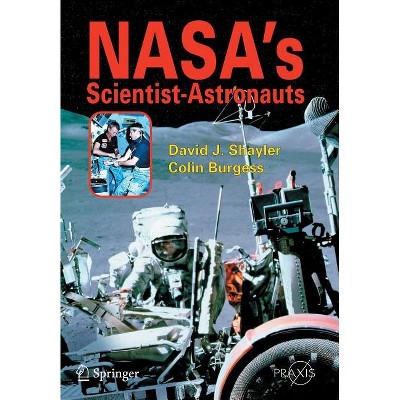
Over the past 35 years more than 100 individual astronauts and cosmonauts have performed nearly 200 EVAs, (spacewalks), either singularly or in teams in Earth orbit, deep space or on the Moon.
Author(s): David Shayler
382 Pages
Science, Physics
Description
Book Synopsis
Over the past 35 years more than 100 individual astronauts and cosmonauts have performed nearly 200 EVAs, (spacewalks), either singularly or in teams in Earth orbit, deep space or on the Moon. In 'Walking in Space: Development of Space Walking Techniques' author, Dave Shayler, shows how hardware and crew members are prepared for, protected and supported during every EVA. He demonstrates how past experiences have led to improved training techniques and how this, in turn, has provided many successes and future developments.
From the Back Cover
On 18 March 1965, just four years after Yuri Gagarin became the first man in space Alexei Leonov left his Voskhod 2 spacecraft and became the first person to perform a space walk. It was on 20 July 1969 that Neil Armstrong took his giant leap for mankind onto the surface of the moon. Then on 7 February 1984 Bruce McCandless became the first human satellite as he flew an untethered manned manoeuvring unit, 300 feet from the shuttle. Five months later on 25 July 1984 Svetlana Savitskaya became the first woman to walk in space. All this was accomplished in less than 20 years.
Two decades later space walking had become an integral part of space operations and will continue be in the forefront of future manned spaceflight activity. We still await the 13th person to step on the moon and the first person to place their footprint on the red plains of Mars. But what does it take to prepare for and conduct a period of activity outside the spacecraft?
In Walking in Space David Shayler explores the development of space walking techniques and support hardware. In a comprehensive but highly readerable review the author draws upon original documentation, personal interviews and official post flight reports revealing the very personal experience of exploring space and the development of training techniques devised in the gravity environment of Earth for work in the vacuum of space, on the moon and eventually on Mars.
Review Quotes
From the reviews:
"Shayler's book provides a step by step account of the development of this extraordinary technique and the technology that supports it. ... It is well researched and referenced, includes a bibliography and an index, and is illustrated with black-and-white photos. A significant addition is the appendix ... . This book provides a comprehensive overview and analysis of space walking and represents a useful addition to the literature." (International Space Review, September, 2005)
"This book is a concise account of the development of the techniques of extra vehicular activity, more commonly known as EVA or 'space walks'. ... tends to provide a good description of the EVA's associated with the various space programmes. ... This book meets all the high quality standards ... books published by Springer-Praxis over the past five years or so." (Jos Heyman, New Bulletin of the Astronautical Society of Western Australia, Vol. 30 (3), 2004)
"David Shayler's latest book looks at one of his favourite subjects, extra vehicular activity, and it shows. It covers all aspects of EVA in both the American and Russian programmes. ... It has a large number of illustrations, technical drawings and a complete record of all EVAs. ... This is an essential book for those who are interested in space walks, the technology as well as Moon walks." (Rex Hall, Spaceflight, Vol. 47 (5), 2005)
"David Shayler's account of the history of extravehicular activity (EVA) is an authoritative tightly packed inventory ... . The minutiae of detail are remarkable. The book has obviously been researched to a high degree ... . This is more a book for someone seriously interested in the subject ... . it is absolutely packed with information, and with its well presented 170 illustrations it is very readable. ... All in all, an excellent and definitive reference book on the subject ... ." (John Masters, Astronomy & Space, February,2005)
Dimensions (Overall): 9.2 Inches (H) x 6.1 Inches (W) x 1.1 Inches (D)
Weight: 1.3 Pounds
Suggested Age: 22 Years and Up
Number of Pages: 382
Genre: Science
Sub-Genre: Physics
Publisher: Springer
Theme: Astrophysics
Format: Paperback
Author: David Shayler
Language: English
Street Date: June 3, 2004
TCIN: 1008938627
UPC: 9781852337100
Item Number (DPCI): 247-16-2690
Origin: Made in the USA or Imported
If the item details aren’t accurate or complete, we want to know about it.
Shipping details
Estimated ship dimensions: 1.1 inches length x 6.1 inches width x 9.2 inches height
Estimated ship weight: 1.3 pounds
We regret that this item cannot be shipped to PO Boxes.
This item cannot be shipped to the following locations: American Samoa (see also separate entry under AS), Guam (see also separate entry under GU), Northern Mariana Islands, Puerto Rico (see also separate entry under PR), United States Minor Outlying Islands, Virgin Islands, U.S., APO/FPO
Return details
This item can be returned to any Target store or Target.com.
This item must be returned within 90 days of the date it was purchased in store, shipped, delivered by a Shipt shopper, or made ready for pickup.