Sponsored
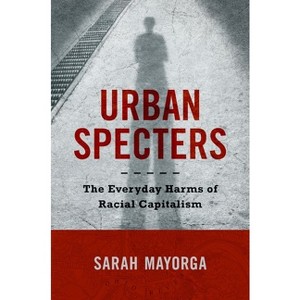
Urban Specters - by Sarah Mayorga Paperback
In Stock
Sponsored
About this item
Highlights
- Racial capitalism, invisible but threaded throughout the world, shapes our lives.
- About the Author: Sarah Mayorga is associate professor of sociology at Brandeis University and is the author of Behind the White Picket Fence: Power and Privilege in a Multiethnic Neighborhood.
- 220 Pages
- Social Science, Sociology
Description
About the Book
"Racial capitalism, invisible but threaded throughout our existence, shapes our lives, argues Sarah Mayorga. Focusing on the experiences and stories of white, Black, and Latinx residents of Cincinnati, Mayorga argues that residents' interpretations, urban specters, are often partial recognitions of the exploitation and dehumanization produced by racial capitalism. In this illuminating and enlightening book, Mayorga identifies small windows into abolitionist possibilities that created different types of relations, ones based on care and connection-this is a guide for anyone trying to understand urban inequality, but also, more importantly, how we might create a different world"--
Book Synopsis
Racial capitalism, invisible but threaded throughout the world, shapes our lives. Focusing on the experiences of white, Black, and Latinx residents of Cincinnati, Sarah Mayorga argues that residents' interpretations of their circumstances, what she calls urban specters, are often partial recognitions of the exploitation and dehumanization produced by racial capitalism. Much scholarly work on racial capitalism has necessarily focused on historical, theoretical, and macro-level accounts. Mayorga takes these vital insights and applies them to two contemporary working-class neighborhoods, centering the lives of working-class and poor people.
Using data from interviews with 117 residents, Mayorga maps how racial capitalism creates the everyday harms people know all too well. Chronic underdevelopment, private property, and policing, she shows, have produced these harms. In this enlightening book, Mayorga identifies small windows into abolitionist possibilities that create different types of relations, ones based on care and connection. This is a guide for anyone trying to understand urban inequality, but also more importantly, for how we might create a different world.
Review Quotes
"[Mayorga] draws on an extensive collection of 117 in-depth interviews from across these two neighborhoods and across racial groups within these areas. The result is a fascinating examination of both race relations and class dynamics in a changing city. . . . In a time of mounting racial strife and economic insecurity, her book provides a solid contribution to urban sociology, social stratification, and critical race studies."--Ethnic and Racial Studies
"Urban Specters helps us make sense of the everyday harm caused by racial capitalism in two working-class urban neighborhoods. It offers us a fresh look at how class relationships are obscured by ideology and how place and race are linked in the minds and lived experiences of everyday people in the city."--Contemporary Sociology
"Urban Specters intimately compares and contrasts two local neighborhoods -- Riverside and Carthage -- and their residents while exploring the topic of racial capitalism. . . . Mayorga uncovers everyday manifestations of racial capitalism through the eyes of Cincinnati residents."--Cincinnati CityBeat
"A fascinating examination of both race relations and class dynamics in a changing city. [Mayorga's] book makes a significant contribution to the study of both critical racial/ethnic studies and urban sociology, and perhaps more importantly to the theoretical underpinnings of these two traditions."--Ethnic and Racial Studies
"A refreshing contribution to urban scholarship. . . . Urban Specters illuminates the ways racial capitalist dynamics haunt the everyday lived experiences of people and, most importantly, the stories people tell. . . . [A] valuable and generative resource for scholars of race, urban inequality, and political economy."--Social Forces
"An in-depth analysis of material life within two neighborhoods in Cincinnati. . . . Urban Specters provides hope in interpersonal acts of resilience and a growing self-awareness made possible by public scholarship that looks at a different world."--The Metropole
"Deeply relational. . . . Mayorga focuses on Riverside and Carthage, yes, but the book becomes most alive when she shows how these places are intimately connected to other worlds: development in other Cincinnati neighborhoods like Over-the-Rhine (p. 35), white flight to suburbs outside the city (p. 41), the migration (of workers and stereotypes
about 'white trash') from the broader Appalachian region that abuts the city (p. 9), or the places her respondents wish they could move (pp. 153-56)."--American Journal of Sociology
"The book uses rich detail from the ground to show how racial capitalism is at work in everyday community life. It also shows the reader how to identify the seeds of abolitionist practices that can be nurtured, demonstrating that abolitionism is not in a different world but rather is present right where racial capitalism dominates and does the most harm."--Sociology of Race and Ethnicity
About the Author
Sarah Mayorga is associate professor of sociology at Brandeis University and is the author of Behind the White Picket Fence: Power and Privilege in a Multiethnic Neighborhood.
Shipping details
Return details
Trending Non-Fiction






Discover more options