Sponsored
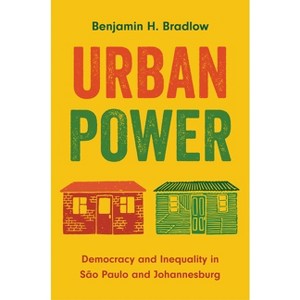
Urban Power - (Princeton Studies in Global and Comparative Sociology) by Benjamin H Bradlow
In Stock
Sponsored
About this item
Highlights
- Why some cities are more effective than others at reducing inequalities in the built environment For the first time in history, most people live in cities.
- About the Author: Benjamin H. Bradlow is assistant professor of sociology and international affairs at Princeton University.
- 256 Pages
- Social Science, Sociology
- Series Name: Princeton Studies in Global and Comparative Sociology
Description
Book Synopsis
Why some cities are more effective than others at reducing inequalities in the built environment
For the first time in history, most people live in cities. One in seven are living in slums, the most excluded parts of cities, in which the basics of urban life--including adequate housing, accessible sanitation, and reliable transportation--are largely unavailable. Why are some cities more successful than others in reducing inequalities in the built environment? In Urban Power, Benjamin Bradlow explores this question, examining the effectiveness of urban governance in two "megacities" in young democracies: São Paulo, Brazil, and Johannesburg, South Africa. Both cities came out of periods of authoritarian rule with similarly high inequalities and similar policy priorities to lower them. And yet São Paulo has been far more successful than Johannesburg in improving access to basic urban goods.
Bradlow examines the relationships between local government bureaucracies and urban social movements that have shaped these outcomes. Drawing on sixteen months of fieldwork in both cities, including interviews with informants from government agencies, political leadership, social movements, private developers, bus companies, and water and sanitation companies, Bradlow details the political and professional conflicts between and within movements, governments, private corporations, and political parties. He proposes a bold theoretical approach for a new global urban sociology that focuses on variations in the coordination of local governing power, arguing that the concepts of "embeddedness" and "cohesion" explain processes of change that bridge external social mobilization and the internal coordinating capacity of local government to implement policy changes.
Review Quotes
"Benjamin Bradlow delivers an illuminating account of urban governance processes and their potential to reduce inequality. . . . Urban Power is a must-read to understand the factors underlying urban inequality and the pivotal role of civil society in urban development."---Simón Escoffier, Perspectives on Politics
"Bradlow's book illuminates how rapid urbanisation, entrenched inequality and fiscal constraints intersect. . . . For anyone interested in the politics of making cities fairer, it is essential reading."---Astrid R.N. Haas, The Conversation
"Urban Power offers an important and intriguing comparison of two cities, and a theoretical framework that should propel research on development and the local state for years to come"---Marcel Paret, The Journal of Development Studies
"Honorable Mention for the Best Book Award, Sociology of Development Section of the American Sociological Association"
"Winner of the Charles Tilly Best Book Award, Collective Behavior and Social Movements section of the American Sociological Association"
"Urban Power is a landmark contribution to the study of urban governance and inequality, particularly in new democracies where addressing persistent patterns of social and spatial exclusion and improving the quality of life for slum residents are urgent priorities."---Ivan Souza Vieira, International Journal of Urban and Regional Research
"Finalist for the Political and Social Sciences Book Award, Forward INDIES"
"Winner of the Best Book Award, Subnational Politics and Society Section of the Latin American Studies Association"
About the Author
Benjamin H. Bradlow is assistant professor of sociology and international affairs at Princeton University.
Shipping details
Return details
Frequently bought together

Trending Non-Fiction


Discover more options