Sponsored
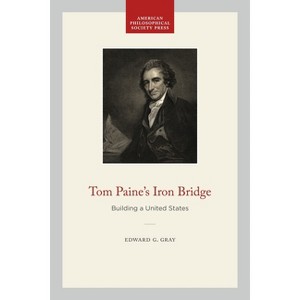
Tom Paine's Iron Bridge - by Edward G Gray (Paperback)
In Stock
Sponsored
About this item
Highlights
- In a letter to his wife, Abigail, John Adams judged the author of Common Sense as having "a better hand at pulling down than building.
- About the Author: Edward G. Gray (1964-2023) has taught early American history at Florida State University since 1999.
- 264 Pages
- History, United States
Description
Book Synopsis
In a letter to his wife, Abigail, John Adams judged the author of Common Sense as having "a better hand at pulling down than building." Adams's dismissive remark has helped shape the prevailing view of Tom Paine ever since. But, as Edward G. Gray shows in this fresh, illuminating work, Paine was a builder. He had a clear vision of success for his adopted country. It was embodied in an architectural project that he spent a decade planning: an iron bridge to span the Schuylkill River at Philadelphia.
When Paine arrived in Philadelphia from England in 1774, the city was thriving as America's largest port. But the seasonal dangers of the rivers dividing the region were becoming an obstacle to the city's continued growth. Philadelphia needed a practical connection between the rich grain of Pennsylvania's backcountry farms and its port on the Delaware. The iron bridge was Paine's solution.
The bridge was part of Paine's answer to the central political challenge of the new nation: how to sustain a republic as large and as geographically fragmented as the United States. The iron construction was Paine's brilliant response to the age-old challenge of bridge technology: how to build a structure strong enough to withstand the constant battering of water, ice, and wind.
The convergence of political and technological design in Paine's plan was Enlightenment genius. And Paine drew other giants of the period as patrons: Benjamin Franklin, George Washington, Thomas Jefferson, and for a time his great ideological opponent, Edmund Burke. Paine's dream ultimately was a casualty of the vicious political crosscurrents of revolution and the American penchant for bridges of cheap, plentiful wood. But his innovative iron design became the model for bridge construction in Britain as it led the world into the industrial revolution.
Review Quotes
"Edward G. Gray's fascinating and important book...reveals that Paine was as committed to building a new order as he was to tearing down the old...[Gray] gives us Paine as we have never seen him before."--Kathleen DuVal "The Wall Street Journal"
"Gray...brings the radical pamphleteer alive as an architect of iron bridges...[and] adds to the body of knowledge about a passionate man and the tumultuous era in which he lived."-- "Publisher's Weekly"
"Highly readable."--Bethany McClean "Strategy + Business"
"Vividly written and rich with insight, this book about [Paine's] attempts to build an ideal America illuminates the nexus of politics, science, and art in the age of revolutions."--Alan Taylor "The Week"
About the Author
Edward G. Gray (1964-2023) has taught early American history at Florida State University since 1999. He served as department chair from Fall of 2013 through summer of 2022. His books include New World Babel: Languages and Nations in Early America (1999), The Making of John Ledyard: Empire and Ambition in the Life of an Early American Traveler (2007), and Mason-Dixon: Crucible of the Nation (2023). He is also co-editor, with Jane Kamensky, of the Oxford Handbook of the American Revolution (2012). Gray's work has been supported by fellowships from the John Carter Brown Library, the Andrew Mellon Foundation/Huntington Library, the National Endowment for the Humanities, the Fulbright Foundation, the American Philosophical Society, and the Florida State University College of Arts & Sciences.
Shipping details
Return details
Trending Non-Fiction




Discover more options