Sponsored
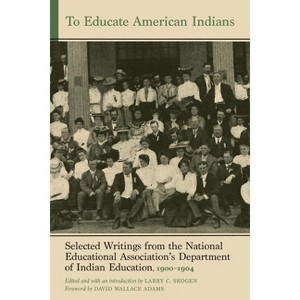
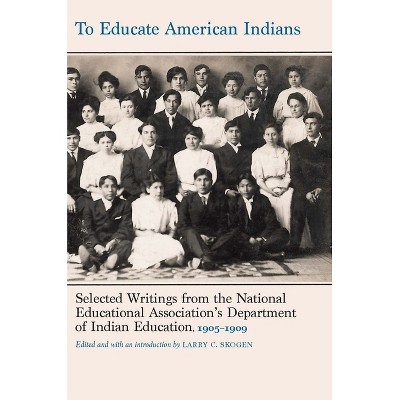
To Educate American Indians - Indigenous Education by Larry C Skogen Hardcover
In Stock
Sponsored
About this item
Highlights
- Winner of the 2025 Dwight L. Smith (ABC-CLIO) AwardTo Educate American Indians presents the most complete versions of papers presented at the National Educational Association's Department of Indian Education meetings during a time when the debate about how best to "civilize" Indigenous populations dominated discussions.
- About the Author: Larry C. Skogen is president emeritus of Bismarck State College, an independent historian, and a retired member of the U.S. Air Force.
- 432 Pages
- Social Science, Ethnic Studies
- Series Name: Indigenous Education
Description
About the Book
To Educate American Indians collects selected writings from the National Educational Association's Department of Indian Education from 1900 to 1904 to examine more fully the tragedy of assimilationism and cultural genocide conducted in federally-run American Indian schools, including the notorious boarding schools.
Book Synopsis
Winner of the 2025 Dwight L. Smith (ABC-CLIO) Award
To Educate American Indians presents the most complete versions of papers presented at the National Educational Association's Department of Indian Education meetings during a time when the debate about how best to "civilize" Indigenous populations dominated discussions. During this time two philosophies drove the conversation. The first, an Enlightenment era-influenced universalism, held that through an educational alchemy American Indians would become productive, Christianized Americans, distinguishable from their white neighbors only by the color of their skin. Directly confronting the assimilationists' universalism were the progressive educators who, strongly influenced by the era's scientific racism, held the notion that American Indians could never become fully assimilated. Despite these differing views, a frightening ethnocentrism and an honor-bound dedication to "gifting" civilization to Native students dominated the writings of educators from the NEA's Department of Indian Education.
For a decade educators gathered at annual meetings and presented papers on how best to educate Native students. Though the NEA Proceedings published these papers, strict guidelines often meant they were heavily edited before publication. In this volume Larry C. Skogen presents many of these unedited papers and gives them historical context for the years 1900 to 1904.
Review Quotes
"Skogen's compilation is a treasure trove for anyone interested in the historical dynamics of American Indian education. His detailed introductions and careful selection of presentation provides readers with a nuanced understanding of the complex and often contentious policies that have shaped Indian education. This collection not only sheds light on the historical context but also encourages reflection on the ongoing challenges and opportunities in the field. Skogen's work is an invaluable resource for educators, policymakers, and tribal communities committed to improving the educational experience of American Indian students. Ignorance of this history makes us prone to repeat the mistakes of the past."--Linda Sue Warner, Tribal College Journal
"As our nation struggles with the realities of the Indian boarding school experience, it is important that we understand the motives and educational philosophies of those who administered and worked at those schools. In this groundbreaking work, Larry Skogen provides us with the story of the Indian service educators when they were part of the National Educational Association. Through these selected papers, we get a firsthand account of their efforts to assimilate Native students forcibly into white society. One cannot read these papers without feeling a sense of shame at the educators' attitudes toward their own Native students. But it is important history that we need to acknowledge."--Byron L. Dorgan, former U.S. Senator and chairman of the U.S. Senate Committee on Indian Affairs, author of The Girl in the Photograph
"The National Education Association is a voice for education professionals and dedicated to preparing students for success in a diverse and interdependent world. That doesn't mean, however, that the NEA hasn't made mistakes and missteps along the way. With this important work, Larry Skogen provides a window into a time when the federal government forced a curriculum upon Native American students that subjugated them into a marginalized role in our country. The papers of the NEA Department of Indian Education (1900-1904) reveal the association's role in advancing this harm. This critical study is a reality check for all Americans to learn our true history so that we better understand the mistakes of our past, can be a part of repairing harm, and can be agents of change to make a better future for all of our students and communities."--Becky Pringle, president of the National Education Association
"These NEA Indian Department presentations, which Larry Skogen does a masterful job of editing, provide an important window into how many people in the United States thought about American Indians and American Indian education in the beginning of the twentieth century. Skogen has done a remarkable job providing the reader with background information, both in his introduction to each document and in the extensive notes and references he provides."--Jon A. Reyhner, author of American Indian Education: A History
"This is important work to enhance the body of knowledge on behalf of Indian Country and our future generations."--Leander "Russ" McDonald (Dakota/Arikara), president of United Tribes Technical College in Bismarck, North Dakota
"Where historians have used the tools of social history to examine the lives of employees in the Indian schools, Skogen's work uses an intellectual lens to demonstrate how these workers drove important changes in curriculum and policy. This detailed and nuanced work helps to untangle the genocidal roots of boarding school systems and to see more clearly the challenges that Native people faced in moving their communities and cultures through the difficult years of the early twentieth century."--Kevin Whalen, author of Native Students at Work: American Indian Labor and Sherman Institute's Outing Program 1900-1945
About the Author
Larry C. Skogen is president emeritus of Bismarck State College, an independent historian, and a retired member of the U.S. Air Force. He is the author of Indian Depredation Claims, 1796-1920. David Wallace Adams (1941-2023) was a professor emeritus of education at Cleveland State University and the author of Education for Extinction: American Indians and the Boarding School Experience, 1875-1928.
Shipping details
Return details
Trending Non-Fiction