Sponsored

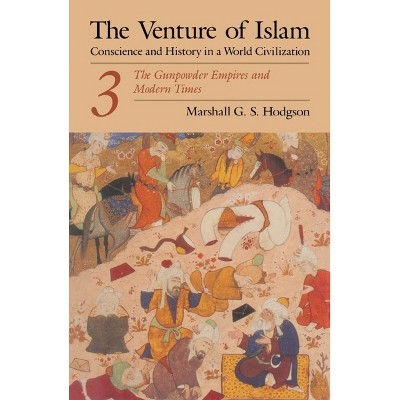
The Venture of Islam, Volume 2 - by Marshall G S Hodgson Paperback
In Stock
Sponsored
About this item
Highlights
- A sweeping work of history that the New Yorker says "demonstrates how history should be written" The Venture of Islam has been honored as a magisterial work of the mind since its publication in early 1975.
- Author(s): Marshall G S Hodgson
- 618 Pages
- History, World
- Series Name: Venture of Islam
Description
Book Synopsis
A sweeping work of history that the New Yorker says "demonstrates how history should be written"
The Venture of Islam has been honored as a magisterial work of the mind since its publication in early 1975. In this three-volume study, illustrated with charts and maps, Hodgson traces and interprets the historical development of Islamic civilization from before the birth of Muhammad to the middle of the twentieth century. This work grew out of the famous course on Islamic civilization that Hodgson created and taught for many years at the University of Chicago.
In the second work of this three-volume set, Hodgson investigates the establishment of an international Islamic civilization through about 1500. This includes a theoretical discussion of cultural patterning in the Islamic world and the Occident.
Review Quotes
"The author's thesis is that, despite [the fragmentation of the Abbasid Caliphate], there developed in this period an international Islamic society which transcended political
boundaries and permitted a Muslim to feel at home wherever Islam had taken root. . . . Hodgson devotes a great deal of attention to subjects which have not previously received such detailed study, especially in general works. . . . In placing Islamic society in a context encompassing not only Islam outside the Middle East proper but contemporarysocieties such as western Europe and China, he provides a perspective sorely missed in most works on the subject."
"This is a nonpareil work, not only because of its command of its subject but also because it demonstrates how, ideally, history should be written."-- "New Yorker"
Shipping details
Return details
Frequently bought together





Trending Non-Fiction





Discover more options