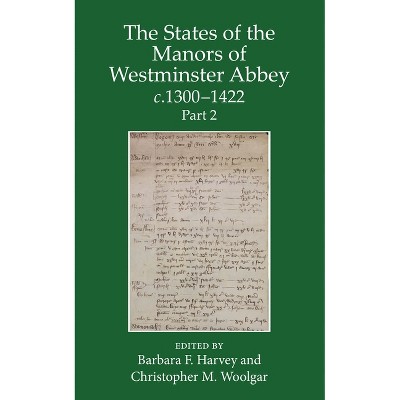
Westminster Abbey was one of the wealthiest and most influential monastic houses in medieval England: c.1300 it held some 38,000 acres, largely in the Home Counties and West Midlands, and its revenues at the Dissolution exceeded £2,800 p.a.
About the Author: Barbara Harvey is an Emeritus Fellow of Somerville College, Oxford, and a Fellow of the British Academy.
336 Pages
History, Civilization
Series Name: Records of Social and Economic History
Description
About the Book
In c.1300, the manors of Westminster Abbey were one of the wealthiest monasteries in late medieval England. This book documents the agricultural economy of the Abbey and demonstrates the sophisticated financial and administrative systems the monks employed in a transition from the direct management of their lands, to systems of leaseholds.
Book Synopsis
Westminster Abbey was one of the wealthiest and most influential monastic houses in medieval England: c.1300 it held some 38,000 acres, largely in the Home Counties and West Midlands, and its revenues at the Dissolution exceeded £2,800 p.a. These assets supported a complement of 50 to 60 monks in the fourteenth century. This volume publishes 75 documents providing overviews ('states') of the Westminster estate and its revenues, as administered by the abbot and convent separately between c.1300 and 1422. The states provided crucial information at a period of great social and economic change either side of the Black Death, assisting in decisions about farming estates directly or leasing them - and to historians today they provide rich evidence of the agricultural economy of medieval England, the systems of provisioning monasteries, and the men who shaped them. The states are of two types. The first gives estimates of corn, stock and cash on the manors, made partway through the financial year - this is unusual information to survive across substantial parts of an estate. The second group has little parallel: summarising the manorial accounts across either the abbot's or the convent's portion of the lands, the states add information about the management of the estate, its value, arrears and so on. In this edition, the Latin text is given of the accounts up to 1375, after which the material is presented in calendared form. The texts are supplemented by a word list and glossary, and an appendix on the abbot's estate officials.
Part 1 of this two-part volume contains the Introduction, the Word List and Glossary, the memoranda and states for the abbot's estates from 1348 to c.1422, along with an appendix on the abbot's estate officials. It also includes the texts of the views and states of the convent's estates from c.1300 up to 1334, all the material of this nature that survives from before the Black Death.
Review Quotes
"Even to skim through these two volumes is enough to give a sense of the richness and importance of the 'states' as mentioned on the first page ... those with an interest in the economic and social history of Westminster Abbey, or of late medieval Europe more generally, will find much here to sink their teeth into.-- "Richard Allen, Journal of Medieval Monastic Studies"
About the Author
Barbara Harvey is an Emeritus Fellow of Somerville College, Oxford, and a Fellow of the British Academy. Her publications have focused on late medieval social, economic and ecclesiastical history and especially on Westminster Abbey and its estates. They include Documents llustrating the Rule of Watler de Wenlok, Abbot of Westminster, 1283-1307; Westminster Abbey and its Estates in the Middle Ages; and Living and Dying in England 1100-1540: The Monastic Experience, which centres on the lives of monks of Westminster Abbey, and which was joint winner of the Wolfson History Prize in 1993.
Chris Woolgar is Professor of History and Archival Studies at the University of Southampton. He has a long-standing interest in the history of the everyday, especially in late medieval England, in patterns of documentation and in editorial work. His publications include Household Accounts from Medieval England, The Great Household in Late Medieval England, The Senses in Late Medieval England, Testamentary Records of the English and Welsh Episcopate 1200-1413 and The Culture of Food in England, 1200-1500. He has been the editor of the Journal of Medieval History since 2009.
Dimensions (Overall): 9.5 Inches (H) x 6.3 Inches (W) x 1.0 Inches (D)
Weight: 1.45 Pounds
Suggested Age: 22 Years and Up
Number of Pages: 336
Genre: History
Sub-Genre: Civilization
Series Title: Records of Social and Economic History
Publisher: Liverpool University Press
Format: Hardcover
Author: Harvey
Language: English
Street Date: February 14, 2020
TCIN: 1008943451
UPC: 9780197266625
Item Number (DPCI): 247-44-5997
Origin: Made in the USA or Imported
If the item details aren’t accurate or complete, we want to know about it.
Shipping details
Estimated ship dimensions: 1 inches length x 6.3 inches width x 9.5 inches height
Estimated ship weight: 1.45 pounds
We regret that this item cannot be shipped to PO Boxes.
This item cannot be shipped to the following locations: American Samoa (see also separate entry under AS), Guam (see also separate entry under GU), Northern Mariana Islands, Puerto Rico (see also separate entry under PR), United States Minor Outlying Islands, Virgin Islands, U.S., APO/FPO
Return details
This item can be returned to any Target store or Target.com.
This item must be returned within 90 days of the date it was purchased in store, shipped, delivered by a Shipt shopper, or made ready for pickup.