Sponsored
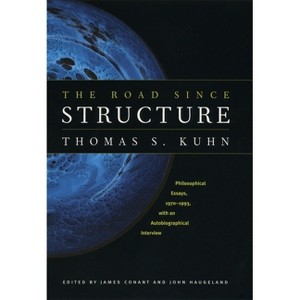
The Road Since Structure - Philosophical Essays, 1970-1993, with an Autobiographical In 2nd Edition by Thomas S Kuhn Paperback
In Stock
Sponsored
About this item
Highlights
- Thomas Kuhn will undoubtedly be remembered primarily for The Structure of Scientific Revolutions, a book that introduced one of the most influential conceptions of scientific progress to emerge during the twentieth century.
- About the Author: James Conant is a professor of philosophy at the University of Chicago.
- 336 Pages
- Science, Philosophy & Social Aspects
- Series Name: Philosophical Essays, 1970-1993, with an Autobiographical In
Description
About the Book
Published in 1962, Kuhn's "The Structure of Scientific Revolutions" is one of the most important works of the 20th century. When he died, Kuhn left an unfinished sequel and a group of essays written since 1970. "The Road since Structure" includes these essays, along with Kuhn's replies to criticism and an interview with Kuhn before his death in 1996. Photos.
Book Synopsis
Thomas Kuhn will undoubtedly be remembered primarily for The Structure of Scientific Revolutions, a book that introduced one of the most influential conceptions of scientific progress to emerge during the twentieth century. The Road Since Structure, assembled with Kuhn's input before his death in 1996, follows the development of his thought through the later years of his life: collected here are several essays extending and rethinking the perspectives of Structure as well as an extensive, fascinating autobiographical interview in which Kuhn discusses the course of his life and philosophy.
From the Back Cover
Thomas Kuhn's The Structure of Scientific Revolutions, published in 1962, is one of the most important works of our time. It has been translated into twenty five languages, and the English edition alone has sold more than one million copies. Structure established Kuhn as the century's most influential philosopher of science, but during the last twenty years of his life, Kuhn was radically rethinking the central concepts of that work. When he died in 1996, he left an unfinished sequel to Structure and a plan for a collection of essays written since 1970.
Divided into three parts, The Road since Structure is the fullest record we now have of the new direction Kuhn was taking during the last two decades of his life. The first part of the book consists of essays, philosophical rather than historical in nature, in which Kuhn refines the basic concepts set forth in Structure--paradigm shifts, incommensurability, and the nature of scientific progress. In part two, Kuhn replies at length to criticisms of his earlier work. Here the reader will find Kuhn arguing his position with some of the most significant philosophers of the time, including Paul Feyerabend and Karl Popper.
The third part of the volume is the transcript of a remarkable autobiographical interview with Kuhn conducted in Athens in 1995, not quite a year before his death. Here, the usually reticent Kuhn discusses his own intellectual development--his family and upbringing, his education, the influence of his training as a physicist, his war work, his relations with his colleagues, the responses to Structure--as well as his struggles to define his philosophical position both before and after that landmark work.
The Road since Structure is the definitive companion to The Structure of Scientific Revolutions. Forceful and accessible, it illuminates and further develops Kuhn's classic book, and it will intrigue everyone who has been engaged by Structure and the debates it launched. In it they will find the story not only of Kuhn's development but also of the man himself.
Review Quotes
"It's sometimes claimed that Kuhn toned down his radical views after Structure, but this is a mistake. He did occasionally repudiate earlier ideas, but the bulk of his later work is a significant articulation and defense of his fundamental views, not a retraction. . . . The Road Since Structure ends with a fascinating 68-page interview with Kuhn, recorded a year before his death. This gives a strong sense of his personality and of the development of his ideas and career. It brings out the extent to which the history of science was for him from the start a vehicle for philosophical inquiry."
--Peter Lipton "London Review of Books"
"The essays fall into three groups, each arranged chronologically. The first shows the development of Kuhn's thought from 1980 through 1990, the second consists of his responses to criticisms of other philosophers, the last is a candid, highly interesting and informative interview Kuhn did a year before his death. . . . His work is central to the question of the relation of science and culture."
-- "Library Journal"
"In 1962, Thomas Kuhn wrote The Structure of Scientific Revolutions, arguing that science proceeds in two ways. 'Normal' science does experiments and expands our knowledge under agreed theories; but 'revolutionary' science introduces a new conceptual framework (a 'paradigm shift'), and demands that we abandon some of what was previously believed. . . . This very useful collection shows the evolution of Kuhn's ideas from 1970, with replies to his critics (including Popper and Feyerabend), and a long interview conducted a year before his death in 1996."-- "Guardian"
"Thomas Kuhn wrote The Structure of Scientific Revolutions in 1962 for a long-forgotten series of monographs called the International Encyclopedia of Unified Science, which is ironic, in retrospect, because Kuhn's masterpiece did not really unify science at all. It broke it open, exposing the inner workings of human creativity and starting, along the way, a thousand arguments."--Malcolm Gladwell "New Yorker"
About the Author
James Conant is a professor of philosophy at the University of Chicago. He is the editor of two books, Hilary Putnam: Realism with a Human Face and Hilary Putnam: Words and Life.
John Haugeland is also a professor of philosophy at the University of Chicago. He is the author of two books, Artificial Intelligence, the Very Idea and Having Thought: Essays in the Metaphysics of Mind, and the editor of two books, Mind Design and Mind Design II.
Shipping details
Return details
Frequently bought together





Trending Non-Fiction






Discover more options