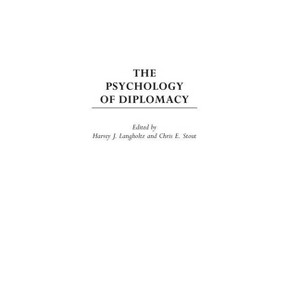
The first book focused on diplomacy from a psychological perspective, this work features 12 top diplomats and psychologists examining issues and approaches.
About the Author: HARVEY J. LANGHOLTZ is Associate Professor of Psychology at the College of William and Mary.
288 Pages
Psychology, General
Series Name: Psychological Dimensions to War and Peace
Description
About the Book
The first book focused on diplomacy from a psychological perspective, this work features 12 top diplomats and psychologists examining issues and approaches. Factors considered include the implicit and explicit ground rules for the interaction of diplomats, and their assumptions about their own roles and those of their counterparts. The book explores the vital question: Do diplomats meet to work out agreements and solutions for the common benefit of humanity, or is it the responsibility of a diplomat to seek advantage for his or her own nation at the expense of others? The topics include ethnic rivalry, water resources, and financial issues. In some cases in this text, the views of psychologists and diplomats are consistent. But there is a gap between the two disciplines. Psychologists tend to be more idealistic, egalitarian, and theory-based, while the diplomats most often focus on the practical realities of dealing with their counterparts and issues where opposing nations seek divergent outcomes.
The actual implementation of diplomacy, and the psychology of diplomacy, takes place not at the global or macro levels, but instead at the one-on-one, micro level. This volume will appeal to students and scholars in students, scholars, and practitioners in psychology, international relations, peace studies, and political science.
Book Synopsis
The first book focused on diplomacy from a psychological perspective, this work features 12 top diplomats and psychologists examining issues and approaches. Factors considered include the implicit and explicit ground rules for the interaction of diplomats, and their assumptions about their own roles and those of their counterparts. The book explores the vital question: Do diplomats meet to work out agreements and solutions for the common benefit of humanity, or is it the responsibility of a diplomat to seek advantage for his or her own nation at the expense of others? The topics include ethnic rivalry, water resources, and financial issues. In some cases in this text, the views of psychologists and diplomats are consistent. But there is a gap between the two disciplines. Psychologists tend to be more idealistic, egalitarian, and theory-based, while the diplomats most often focus on the practical realities of dealing with their counterparts and issues where opposing nations seek divergent outcomes.
The actual implementation of diplomacy, and the psychology of diplomacy, takes place not at the global or macro levels, but instead at the one-on-one, micro level. This volume will appeal to students and scholars in students, scholars, and practitioners in psychology, international relations, peace studies, and political science.
Review Quotes
?Langholz and Stout have produced a profound book on psychology and diplomacy....Recommended. Graduate collections and above.?-Choice
"Langholz and Stout have produced a profound book on psychology and diplomacy....Recommended. Graduate collections and above."-Choice
About the Author
HARVEY J. LANGHOLTZ is Associate Professor of Psychology at the College of William and Mary. He is a Special Senior Fellow of the United Nations Institute for Training and Research. He is also Series Editor for the Praeger series, Psychological Dimensions to War and Peace, and the Editor of Kluwer Law International's International Peacekeeping Yearbook. From 1991 to 1993 he was a U.S. Delegate to the United Nations, including service with the Special Committee on Peacekeeping Operations.
CHRIS E. STOUT is Adjunct Associate Professor of Psychology at the Northwestern University Medical School, and a Visiting Clinical Professor at the University of Illinois College of Medicine. He serves as Illinois' first Chief of Psychological Services. He served as an NGO Special Representative to the United Nations, was appointed by the U.S. Department of Commerce as a Baldridge Examiner, and has served as an advisor to the White House for both political parties.
Dimensions (Overall): 9.54 Inches (H) x 6.48 Inches (W) x 1.02 Inches (D)
Weight: 1.26 Pounds
Suggested Age: 22 Years and Up
Number of Pages: 288
Genre: Psychology
Sub-Genre: General
Series Title: Psychological Dimensions to War and Peace
Publisher: Praeger
Format: Hardcover
Author: Harvey Langholtz
Language: English
Street Date: April 30, 2004
TCIN: 1007349542
UPC: 9780275971441
Item Number (DPCI): 247-52-1736
Origin: Made in the USA or Imported
If the item details aren’t accurate or complete, we want to know about it.
Shipping details
Estimated ship dimensions: 1.02 inches length x 6.48 inches width x 9.54 inches height
Estimated ship weight: 1.26 pounds
We regret that this item cannot be shipped to PO Boxes.
This item cannot be shipped to the following locations: American Samoa (see also separate entry under AS), Guam (see also separate entry under GU), Northern Mariana Islands, Puerto Rico (see also separate entry under PR), United States Minor Outlying Islands, Virgin Islands, U.S., APO/FPO
Return details
This item can be returned to any Target store or Target.com.
This item must be returned within 90 days of the date it was purchased in store, shipped, delivered by a Shipt shopper, or made ready for pickup.