Sponsored
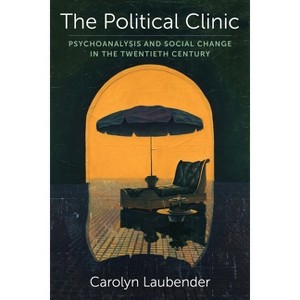
The Political Clinic - (New Directions in Critical Theory) by Carolyn Laubender
In Stock
Sponsored
About this item
Highlights
- Winner, 2025 Book Prize of the American Psychoanalytic Association Winner, 2025 Book Award of the British Psychological Society For decades, psychoanalysis has provided essential concepts and methodologies for critical theory and the humanities and social sciences.
- About the Author: Carolyn Laubender is an associate professor in the Department of Psychosocial and Psychoanalytic Studies and the founding codirector of the MA in Gender and Sexuality Studies at the University of Essex.
- 360 Pages
- Political Science, History & Theory
- Series Name: New Directions in Critical Theory
Description
About the Book
Carolyn Laubender examines cases from Britain and its former colonies to show that clinical psychoanalytic practice constitutes a productive site for novel political thought, theorization, and action.
Book Synopsis
Winner, 2025 Book Prize of the American Psychoanalytic Association
Winner, 2025 Book Award of the British Psychological Society
For decades, psychoanalysis has provided essential concepts and methodologies for critical theory and the humanities and social sciences. But it is also, inseparably, a clinical practice and technique for treatment. In what ways is clinical practice significant for critical thought? What conceptual resources does the clinic hold for us today?
Carolyn Laubender examines cases from Britain and its former colonies to show that clinical psychoanalytic practice constitutes a productive site for novel political thought, theorization, and action. She delves into the clinical work of some of the British Psychoanalytic Society's most influential practitioners--including Anna Freud, Melanie Klein, Wulf Sachs, D. W. Winnicott, Thomas Main, and John Bowlby--exploring how they developed distinctive and politically salient practices. Laubender argues that these figures transformed the clinic into a laboratory for reimagining race, gender, sexuality, childhood, nation, and democracy. By taking up the clinic as both a site of inquiry and realm of theoretical innovation, she traces how political concepts such as authority, reparation, colonialism, decolonization, communalism, and security at once informed and were reformed by each analyst's work.
While psychoanalytic scholarship has typically focused on its intellectual, social, and political effects outside of the clinic, this interdisciplinary book combines history with feminist and decolonial social theory to recast the clinic as a necessarily politicized space. Challenging common assumptions that psychoanalytic practice is or should be neutral, apolitical, and objective, The Political Clinic also considers what progressive clinical praxis can offer today.
Review Quotes
An indispensable tour d'horizon... The Political Clinic offers a panoramic, thoroughly researched, and deft intellectual history of the interweaving of psychoanalysis and social change and nuanced interpretations of critical analytic figures. Substantively, these readings open rich terrains for future research; they also model an extraordinary citational generosity, thus making the project a collective one and inviting in new readers. Laubender's book will be indispensable to future researchers.-- "Perspectives on Politics"
Suitable for psychoanalytically sophisticated readers. Recommended.-- "Choice"
This book should be mandatory reading in clinical training programs where theorists are often taught without context or any critical address to the social and political implications underpinning their work. Laubender's book shows how clinical work is impacted by historical and political life and the circumstance of analysts, patients, and societies. The clinic is necessarily political.-- "Psychoanalytic Psychology"
We have long searched and waited for a work like Carolyn Laubender's The Political Clinic...This text is crucial for the analyst who is seeking ways to transform their practice and understands the ways in which the political clinic has the potential to not only transform the lives of the analysand but also the clinician and more broadly the society in which we inhabit.-- "European Journal of Psychotherapy & Counselling"
Laubender's fiercely argued book rewrites everything we knew about the politicality of the psychoanalytic clinic. Seething with ironies and illuminations--there is no clinical gesture (defenses, reparation, secure attachment) that is not embedded in its Cold War and decolonial histories, its geopolitical imaginaries. It's where psychoanalysis must struggle to go.--Matt ffytche, coeditor of Psychoanalysis in the Age of Totalitarianism
Revisiting previous historical experiments, Laubender gives us a searing perspective on our much-troubled present. Generous, deft reinterpretations of classic cases by legendary British psychoanalysts--including an ingenious take on Winnicott resituated in Windrush-era racial conflict--are framed by a brilliantly incisive assessment of the perilous politics currently roiling the wider therapeutic scene.--Dagmar Herzog, author of Cold War Freud and The Question of Unworthy Life
Laubender's intervention into the clinical turn shows how political theories emerge in psychoanalytic praxis through the transferential and counter-transferential relation. Reading analysts in their clinics, she sheds light on the politics and situatedness of psychoanalysis, as well as its class, race, and national specificity.--Ranjana Khanna, author of Dark Continents: Psychoanalysis and Colonialism
About the Author
Carolyn Laubender is an associate professor in the Department of Psychosocial and Psychoanalytic Studies and the founding codirector of the MA in Gender and Sexuality Studies at the University of Essex.
Shipping details
Return details
Frequently bought together






Trending Non-Fiction