Sponsored
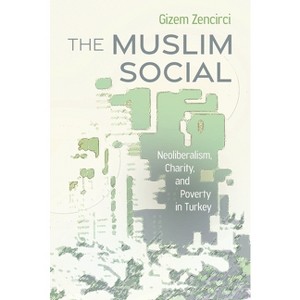
The Muslim Social - (Contemporary Issues in the Middle East) by Gizem Zencirci (Paperback)
In Stock
Sponsored
About this item
Highlights
- Since coming to power in 2002, Turkey's governing party, the AKP, has made poverty relief a central part of their political program.
- About the Author: Gizem Zencirci is an associate professor of political science at Providence College.
- 304 Pages
- Social Science, Islamic Studies
- Series Name: Contemporary Issues in the Middle East
Description
About the Book
"Zencirci introduces the concept of the Muslim Social, defined as a welfare regime that reimagined and reconfigured Islamic charitable practices to address the complex needs of a modern market society. Although these governmental assemblages of Islamic neoliberalism produced new forms of generosity, distinctive notions of poverty, and novel ways of relating to others in society, Zencirci reveals how this welfare regime privileged managerial efficiency and emotional well-being at the expense of other objectives such as equality, development, or justice"--
Book Synopsis
Since coming to power in 2002, Turkey's governing party, the AKP, has made poverty relief a central part of their political program. In addition to neoliberal reforms, AKP's program has involved an emphasis on Islamic charity that is unprecedented in the history of the Turkish Republic. To understand the causes and consequences of this phenomenon, Zencirci introduces the concept of the Muslim Social, defined as a welfare regime that reimagined and reconfigured Islamic charitable practices to address the complex needs of a modern market society.
In The Muslim Social, Zencirci explores the blending of religious values and neoliberal elements in dynamic, flexible, and unexpected ways. Although these governmental assemblages of Islamic neoliberalism produced new forms of generosity, distinctive notions of poverty, and novel ways of relating to others in society, Zencirci reveals how this welfare regime privileged managerial efficiency and emotional well-being at the expense of other objectives such as equality, development, or justice. The book provides a lens onto the everyday life of Islamic neoliberalism, while also mapping the kind of political concerns that animate poverty governance in our capitalist present.
Review Quotes
In her well-written, meticulously researched, and strongly theorized book, Zencirci raises a challenge against analyses of contemporary Islamic practices that picture them as either capitalist and modern or anti-capitalist and anti-modern.-- "Cihan Tugal, Contemporary Sociology"
Scholars interested in a powerful and clear operationalization of governmentality and assemblage theory via a richly textured ethnography will also find much to consider in this volume.-- "Aziz, Ardic, Voluntas"
Zencirci's meticulously researched book stands out as both highly original and conceptually and empirically advanced. It makes a significant contribution to the literature on the intersection of Islam and capitalism.-- "Gorkem Altinors, Turkish Studies"
In this groundbreaking work, Gizem Zencirci introduces the notion of the 'Muslim social' as a regime which brings together neoliberal economic practices with welfare commitments through the unique functioning of Islamic charity organizations. Zencirci makes important contributions by focusing on the contextual contingency and the fluidity of sociopolitical economic practices such as neoliberalism.-- "Alev Çinar, author of Modernity, Islam, and Secularism in Turkey"
Valuable insights are provided from rich ethnographic data.
-- "Osman Savaskan, Marmara University, Turkey"A carefully researched, theoretically sophisticated contribution to an emerging body of scholarship on Islam and capitalism. This book argues that focusing on charity can reveal how capitalism works. This is an acute insight. Zencirci convincingly demonstrates that, far from being antithetical to capitalism, social interventions in the name of humanitarianism and charity can in fact be constitutive of it.-- "Daromir Rudnyckyj, author of Beyond Debt: Islamic Experiments in Global Finance"
About the Author
Gizem Zencirci is an associate professor of political science at Providence College. Her work has been published in journals such as the International Journal of Mid-dle East Studies, Journal of the American Academy of Religion, and the Journal of Cultural Economy.
Shipping details
Return details
Frequently bought together



Trending Non-Fiction