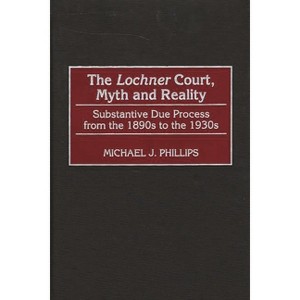
Conventional wisdom holds that the Lochner Court illegitimately used the Constitution's due process clauses to strike down Progressive legislation designed to protect the poor and powerless against big business.
About the Author: Michael J. Phillips is professor emeritus of business administration at Indiana University's Kelley School of Business.
224 Pages
Freedom + Security / Law Enforcement, Civil Procedure
Description
About the Book
Conventional wisdom holds that the Lochner Court illegitimately used the Constitution's due process clauses to strike down Progressive legislation designed to protect the poor and powerless against big business. This book systematically examines all of the U.S. Supreme Court's substantive due process cases from 1897 through 1937 and finds that they do not support long-held beliefs about the Lochner Court. The Court was more Progressive than commonly imagined, striking down far fewer laws on substantive due process grounds than is generally believed. The laws it overturned were not invariably social legislation, and relatively few due process cases involved freedom of contract. Moreover, Holmes, despite his reputation as a Great Dissenter, joined many of the cases striking down government action.
The book attacks three familiar normative criticisms of the Lochner Court. It accerts that (1) the Court's substantive due process decisions almost certainly were not motivated by a conscious desire to assist business by suppressing social legislation; only sometimes did the justices' nostalgia for laissez-faire lead to this result; (2) the conservative justices' understanding of business and government often exceeded that found in the typical Brandeis Brief; and (3) most applications of Lochner-era substantive due process cannot readily be described as illegitimate assertions of judicial power lacking justification in the due process clauses.
Book Synopsis
Conventional wisdom holds that the Lochner Court illegitimately used the Constitution's due process clauses to strike down Progressive legislation designed to protect the poor and powerless against big business. This book systematically examines all of the U.S. Supreme Court's substantive due process cases from 1897 through 1937 and finds that they do not support long-held beliefs about the Lochner Court. The Court was more Progressive than commonly imagined, striking down far fewer laws on substantive due process grounds than is generally believed. The laws it overturned were not invariably social legislation, and relatively few due process cases involved freedom of contract. Moreover, Holmes, despite his reputation as a Great Dissenter, joined many of the cases striking down government action.
The book attacks three familiar normative criticisms of the Lochner Court. It accerts that (1) the Court's substantive due process decisions almost certainly were not motivated by a conscious desire to assist business by suppressing social legislation; only sometimes did the justices' nostalgia for laissez-faire lead to this result; (2) the conservative justices' understanding of business and government often exceeded that found in the typical Brandeis Brief; and (3) most applications of Lochner-era substantive due process cannot readily be described as illegitimate assertions of judicial power lacking justification in the due process clauses.
Review Quotes
.,."this is an important and interesting book, and one that should be read by anyone with an interest in the Lochner era."-Law and History Review
?...this is an important and interesting book, and one that should be read by anyone with an interest in the Lochner era.?-Law and History Review
..."this is an important and interesting book, and one that should be read by anyone with an interest in the Lochner era."-Law and History Review
About the Author
Michael J. Phillips is professor emeritus of business administration at Indiana University's Kelley School of Business. During his 23 years at Indiana University he wrote more than 40 law journal articles, served as editor-in-chief of the American Business Law Journal, and coauthored two business law texts. He is also the author of Ethics and Manipulation in Advertising: Answering the Flawed Indictment (Quorum, 1997) and The Dilemmas of Individualism: Status, Liberty, and American Constitutional Law (Greenwood, 1983).
Dimensions (Overall): 9.46 Inches (H) x 6.34 Inches (W) x .88 Inches (D)
Weight: 1.15 Pounds
Suggested Age: 22 Years and Up
Number of Pages: 224
Genre: Freedom + Security / Law Enforcement
Sub-Genre: Civil Procedure
Publisher: Praeger
Format: Hardcover
Author: Michael J Phillips
Language: English
Street Date: November 30, 2000
TCIN: 1005058932
UPC: 9780275969301
Item Number (DPCI): 247-29-0629
Origin: Made in the USA or Imported
If the item details aren’t accurate or complete, we want to know about it.
Shipping details
Estimated ship dimensions: 0.88 inches length x 6.34 inches width x 9.46 inches height
Estimated ship weight: 1.15 pounds
We regret that this item cannot be shipped to PO Boxes.
This item cannot be shipped to the following locations: American Samoa (see also separate entry under AS), Guam (see also separate entry under GU), Northern Mariana Islands, Puerto Rico (see also separate entry under PR), United States Minor Outlying Islands, Virgin Islands, U.S., APO/FPO
Return details
This item can be returned to any Target store or Target.com.
This item must be returned within 90 days of the date it was purchased in store, shipped, delivered by a Shipt shopper, or made ready for pickup.