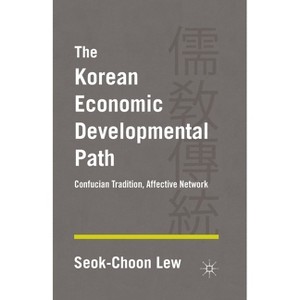
This book defines the Korean development as the moral economy of growth derived from a synergy between strong state and strong society and argues that Confucian cultural orientation has played a critical role in the process.
About the Author: Seok-Choon Lew is a Professor of Sociology/Area Studies and the Director of Syngman Rhee Institute at Yonsei University, Seoul, Korea.
211 Pages
Political Science, American Government
Description
Book Synopsis
This book defines the Korean development as the moral economy of growth derived from a synergy between strong state and strong society and argues that Confucian cultural orientation has played a critical role in the process.
Review Quotes
"This is a provocative addition to the literature, by a sociologist, who finds a big gap in existing models of economic development. Taking a fresh look at the concept of social capital, Lew supplements the dichotomy of state-civil society with that of strong state-strong society, based on affective networks, including blood relations, school ties, and localism. He points to 'disciplinary ethos' as a means for keeping the state from being captured by special interests. Concentrating on the example of Korea and on its Confucian traditions, Lew puts culture at center stage in presenting a novel take on how the social sciences should interpret the phenomenal record of East Asian development, arguing that globalization is not incompatible with a strong state and a society still steeped in bonds many thought were unsuitable to our era." - Gilbert Rozman, Emeritus Musgrave Professor of Sociology, Princeton University, USA, and Editor-in-chief, The Asan Forum
"This project will regenerate much interest among students of East Asian patterns of development at large...A proper understanding of the yongo kwan'gye is a key to understanding not only contemporary Korean society, but also its people and the foundation of their social networking which Lew refers to as 'affective networks.' This is a fine contribution to studies of Confucian capitalism and in particular, strong state-strong society relations, in the context of Korea." - Hyung-A Kim, Associate Professor, Australian National University
"The book's culture-oriented narrative is fascinating, alluring, and even intuitive. It takes us back to those questions of economic development about which the Nobel laureate Robert Lucas famously stated, 'Once one starts to think about them, it is hard to think about anything else.' Strikingly, in that same quote, Lucas asks, 'If not [economic policies], what is it about the "nature of India" that makes it so [stagnant]?' Indeed, why Korea and not India? The book shows us where the answer may lie: each country's unique cultural and historical context from which they must 'find their own recipes' (p. 181) for successful development.
Regarding readership, [...] budding students of modern Korea [...] would likely find this book highly readable and insightful. [...] This book should also be instructive for those economists and political economists exploring new avenues of research, such as culture, in economic growth and development." Taejoon Han, The Journal of Asian Studies
About the Author
Seok-Choon Lew is a Professor of Sociology/Area Studies and the Director of Syngman Rhee Institute at Yonsei University, Seoul, Korea.
Dimensions (Overall): 8.5 Inches (H) x 5.5 Inches (W) x .5 Inches (D)
Weight: .61 Pounds
Suggested Age: 22 Years and Up
Number of Pages: 211
Genre: Political Science
Sub-Genre: American Government
Publisher: Palgrave MacMillan
Theme: National
Format: Paperback
Author: S Lew
Language: English
Street Date: December 16, 2013
TCIN: 1008780206
UPC: 9781349471683
Item Number (DPCI): 247-22-3233
Origin: Made in the USA or Imported
If the item details aren’t accurate or complete, we want to know about it.
Shipping details
Estimated ship dimensions: 0.5 inches length x 5.5 inches width x 8.5 inches height
Estimated ship weight: 0.61 pounds
We regret that this item cannot be shipped to PO Boxes.
This item cannot be shipped to the following locations: American Samoa (see also separate entry under AS), Guam (see also separate entry under GU), Northern Mariana Islands, Puerto Rico (see also separate entry under PR), United States Minor Outlying Islands, Virgin Islands, U.S., APO/FPO
Return details
This item can be returned to any Target store or Target.com.
This item must be returned within 90 days of the date it was purchased in store, shipped, delivered by a Shipt shopper, or made ready for pickup.