Sponsored
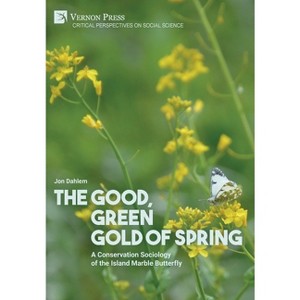
The Good, Green Gold of Spring - (Critical Perspectives on Social Science) by Jon Dahlem (Hardcover)
In Stock
Sponsored
About this item
Highlights
- This book presents a case study of Island Marble Butterfly (IMB) conservation from an environmental sociological perspective.
- Author(s): Jon Dahlem
- 170 Pages
- Nature, Environmental Conservation & Protection
- Series Name: Critical Perspectives on Social Science
Description
Book Synopsis
This book presents a case study of Island Marble Butterfly (IMB) conservation from an environmental sociological perspective. Using qualitative methods, the study explicates various social components of a collaboration of stakeholders working together to protect the species from extinction. Rediscovered in 1998 after being presumed extinct for nearly a century, the IMB persists exclusively among the San Juan Islands, WA, where the efforts of scientists, local conservationists, government employees, and non-profit organizations have sustained the species, even achieving a listing under the Endangered Species Act. For these reasons and many others, the IMB presents a case in some ways fascinating for its idiosyncrasies and in other ways indicative of broader trends in conservation work in an era of rapid global biodiversity loss.
From the study emerges a call for increased sociological research that contributes knowledge beneficial to conservation practice, or what the book calls "conservation sociology." The book reviews existing literature in this space and provides a framework for constructing research, theory, and application in conservation sociology. As the social components of IMB conservation are explored, so too are components of conservation sociology. The book describes competing norms and beliefs among IMB stakeholders, demonstrating the capacity of conservation sociology to describe and interpret social phenomena in conservation work; explores power dynamics in the collaboration, using sociological theory to interpret significant events in IMB conservation; and analyzes the significance of time in IMB conservation while providing suggestions for applied conservation work based in sociological perspectives.
The book accomplishes three main goals. First, it provides an account of details and events in Island Marble Butterfly conservation. Second, it defines, positions, and develops conservation sociology. Third, it demonstrates original research in conservation sociology, resulting in a deep look at the complexities of the social components of species conservation.
Review Quotes
A specifically sociological perspective has been largely absent thus far from the rapidly growing field of critical conservation studies. In "The Good, Green Gold of Spring", Jon Dahlem convincingly demonstrates this perspective's unique contribution to both research and practice aiming to confront the impending sixth extinction crisis.
Dr. Robert Fletcher
Wageningen University & Research
Jon Dahlem has produced something environmental sociologists have needed for a very long time: a "conservation sociology." Through an extensive case study of the Island Marble Butterfly, Dahlem shows how we can both seek to understand as well as advocate for efforts to conserve biodiversity during this age of the sixth great extinction. What is more, Dahlem has a knack for presenting complex ideas and processes in a relatable manner. He has a deep respect for natural science, though situates both natural and social science within its proper historical, cultural, and political contexts. This book should be welcomed by anyone concerned about drastic environmental change.
Dr. Jordan Fox Besek
Department of Sociology
State University of New York at Buffalo
What can the Island Marble butterfly-a thumbnail-sized insect-tell us about society? Jon Dahlem answers this question with social scientific rigor in "The Good, Green Gold of Spring." His ethnography transports readers to the lush San Juan Islands in Washington state, where the Island Marble butterfly commands attention from conservationists who clash over how to study and care for the species. Dahlem's thoughtful analysis also situates IMB conservation in a broader social and political context, where conservationists' actions reveal truths about power, inequality, and the environment. Dahlem deftly connects his observations of butterfly-human interactions to larger themes and debates in social science. His elegant depiction of waiting to observe an IMB's first flight-an ability that will only last for seven days before it dies-underscores the important, and often incongruent, relationship between sociocultural and biophysical time as a key challenge in conservation movements.
The book's call for a conservation sociology is innovative and well-supported by data. The discipline of sociology has much to offer conservation efforts-namely, the perspective that science cannot be separated from the people who do it and the systems they exist in. "The Good, Green Gold of Spring" charts a roadmap for how sociologists can describe problems and prescribe solutions for the pressing needs of species conservation.
Dr. Pierce Greenberg
Department of Sociology
Creighton University
Shipping details
Return details
Trending Non-Fiction