Sponsored
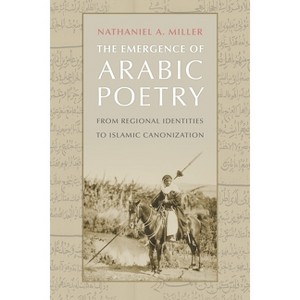
The Emergence of Arabic Poetry - by Nathaniel A Miller Hardcover
In Stock
Sponsored
About this item
Highlights
- To interpret the Quran's Arabic, early medieval Muslims turned to pre-Islamic poetry, a corpus that the Prophet Muhammad's cousin called "the archive of the Arabs.
- About the Author: Nathaniel A. Miller is an independent scholar and translator, specializing in Arabic language and literature.
- 376 Pages
- History,
Description
About the Book
"Medieval Arabic poetry has long been used to understand the language of the Quran. This book explores how it achieved this role, and narrates how it developed historically as late antique Arabians interacted with the Persian and Roman empires, whose empires they largely conquered with the coming of Islam"--
Book Synopsis
To interpret the Quran's Arabic, early medieval Muslims turned to pre-Islamic poetry, a corpus that the Prophet Muhammad's cousin called "the archive of the Arabs." While this principle seems straightforward, pre-Islamic Arabs did not, in fact, think of themselves as either pre-Islamic or Arab. The term Arab barely appears at all in pre-Islamic poetry.
The Emergence of Arabic Poetry reexamines this early poetry to reconstruct what pre-Islamic culture actually entailed. Nathaniel A. Miller draws on a wide range of texts, including hundreds of lines of poetry never before translated into English--in addition to new inscriptional, archaeological, and non-Arabic sources--to explore the diverse world of pre- and early-Islamic Arabia in which Islam developed. Miller traces the emergence of two regional identities, and their distinctive poetic traditions, in the Arabian Peninsula of late antiquity: Najdi in the center and northeast and Hijazi in the southwest. The book shows how later efforts of Muslim scholars to use early poetry as an aesthetic, linguistic ideal to interpret the Quran resulted in an image of a unitary, exceptional, and isolated Arab identity and culture. These scholars drew on the Najdi tradition, canonizing its forms as classical Arabic poetry par excellence, and solidifying many tropes of Arabness that are still ubiquitous today: of nomadism, performative generosity, and martial equestrianism. However, Miller argues, it was the neglected Hijazi tradition that was actually more central to the emergence of early Islam.
Early Arabic poetry has been largely overlooked in current scholarship in adjacent fields, largely due to twentieth-century controversies over whether this corpus is legitimate or was forged. In combining a reconstruction of pre-Islamic poetry's social function with a consideration of the circumstances of its later canonization, The Emergence of Arabic Poetry offers an urgently needed reappraisal of a significant but underexamined poetic corpus, as well as a new literary history of the origins of Arabic poetry from 500 to 750 CE.
Review Quotes
"Outstanding and persuasive, this book is a major work that will alter the field. Nathaniel A. Miller has a real command of a range of difficult primary texts, and his assessment of their wider significance opens many new vistas of scholarship."-- "Philip Wood, Institute for the Study of Muslim Civilisations, Aga Khan University"
"The task of making sense of the extant corpus of early Arabic poetry in the context of the late antique world--demanding as it does a very high degree of linguistic and other expertise--has so far remained outstanding. This pioneering, thoroughly impressive book finally accomplishes the desideratum, providing an unrivaled picture of pre-Islamic Arabic poetry."-- "Nicolai Sinai, University of Oxford"
About the Author
Nathaniel A. Miller is an independent scholar and translator, specializing in Arabic language and literature.
Shipping details
Return details
Frequently bought together





Trending Non-Fiction





Discover more options