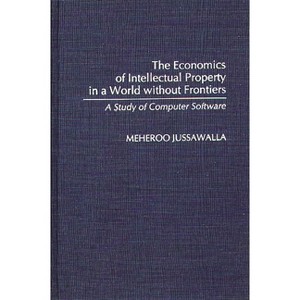
This work explores the problems arising from dynamic information technology in its application to intellectual property rights.
About the Author: MEHEROO JUSSAWALLA is research associate and economist for the Institute of Culture and Communication of the East-West Center in Honolulu.
168 Pages
Freedom + Security / Law Enforcement, Property
Series Name: Contributions in Economics and Economic History
Description
About the Book
This work explores the problems arising from dynamic information technology in its application to intellectual property rights. In a global marketplace of ideas, political boundaries and the sovereignty of the nation state seem to be disappearing because of the increasing difficulty of scrutinizing the infringement of intellectual property. That is particularly true of computer software, the focus of this book. The work analyzes the legal and political economy implications of investment in the software programming industry and the near-futility of monitoring protection of intellectual property in industry.
The book begins by exploring the current state of copyright laws for computer software. It analyzes the economic theories of demand elasticities, public choice, clubs, and the concept of public goods as those theories apply to intellectual property, particularly computer software. This analysis is followed by a discussion of prevailing legislation in the United States, Europe, Japan, Asia, and China. The analysis is fortified by a comprehensive coverage of the Uruguay Round. The work concludes in favor of the free flow of information, which yields overwhelming benefits to a globally integrated market.
Book Synopsis
This work explores the problems arising from dynamic information technology in its application to intellectual property rights. In a global marketplace of ideas, political boundaries and the sovereignty of the nation state seem to be disappearing because of the increasing difficulty of scrutinizing the infringement of intellectual property. That is particularly true of computer software, the focus of this book. The work analyzes the legal and political economy implications of investment in the software programming industry and the near-futility of monitoring protection of intellectual property in industry.
The book begins by exploring the current state of copyright laws for computer software. It analyzes the economic theories of demand elasticities, public choice, clubs, and the concept of public goods as those theories apply to intellectual property, particularly computer software. This analysis is followed by a discussion of prevailing legislation in the United States, Europe, Japan, Asia, and China. The analysis is fortified by a comprehensive coverage of the Uruguay Round. The work concludes in favor of the free flow of information, which yields overwhelming benefits to a globally integrated market.
Review Quotes
?First, it is an excellent statement of the economic theory supporting the market on intellectual property If you are interested in economic theory, I recommend buying it.?-ALR
?The book is well organized and lucidly written as a useful and up-to-date reference list. It may be profitably read by anyone interested in this increasingly important topic, and should prove to be a valuable addition to the literature.?-The Southern Economic Journal
"First, it is an excellent statement of the economic theory supporting the market on intellectual property If you are interested in economic theory, I recommend buying it."-ALR
"The book is well organized and lucidly written as a useful and up-to-date reference list. It may be profitably read by anyone interested in this increasingly important topic, and should prove to be a valuable addition to the literature."-The Southern Economic Journal
About the Author
MEHEROO JUSSAWALLA is research associate and economist for the Institute of Culture and Communication of the East-West Center in Honolulu. She is the author of Information Technology and Global Interdependence (Greenwood, 1989), Telecommunication Economics and International Regulatory Policy (Greenwood, 1986), and The Cost of Thinking: Primary Information Sectors of Ten Pacific Countries (1988).
Dimensions (Overall): 8.5 Inches (H) x 5.5 Inches (W) x .5 Inches (D)
Weight: .8 Pounds
Suggested Age: 22 Years and Up
Number of Pages: 168
Genre: Freedom + Security / Law Enforcement
Sub-Genre: Property
Series Title: Contributions in Economics and Economic History
Publisher: Praeger
Format: Hardcover
Author: Meheroo Jussawalla
Language: English
Street Date: February 20, 1992
TCIN: 1005059201
UPC: 9780313276200
Item Number (DPCI): 247-29-5148
Origin: Made in the USA or Imported
If the item details aren’t accurate or complete, we want to know about it.
Shipping details
Estimated ship dimensions: 0.5 inches length x 5.5 inches width x 8.5 inches height
Estimated ship weight: 0.8 pounds
We regret that this item cannot be shipped to PO Boxes.
This item cannot be shipped to the following locations: American Samoa (see also separate entry under AS), Guam (see also separate entry under GU), Northern Mariana Islands, Puerto Rico (see also separate entry under PR), United States Minor Outlying Islands, Virgin Islands, U.S., APO/FPO
Return details
This item can be returned to any Target store or Target.com.
This item must be returned within 90 days of the date it was purchased in store, shipped, delivered by a Shipt shopper, or made ready for pickup.