About the Author: Ali Arabnya, PhD, is the Director of Infrastructure Finance and Climate Risk with Quanta Technology and a Research Professor of Electrical and Computer Engineering with the University of Denver.
256 Pages
Business + Money Management, Environmental Economics
Description
About the Book
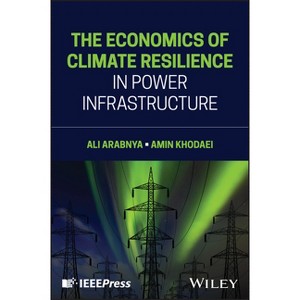
"The economic and financial losses caused by climate-related events such as wildfires, heat waves, and hurricanes can reach hundreds of billions of dollars, threatening the financial health and solvency of the utilities and local governments. In addition, they can significantly hinder the ability of utilities and infrastructure owners to recover, which can lead to dire consequences for shareholders, ratepayers, and policymakers. That requires developing a wide range of innovative engineering economic solutions to achieve the financial, operational, and physical resilience expected from a 21st century power infrastructure. Therefore, the economics of resilience should be incorporated in technological solutions to streamline the success of climate adaptation measures in the power & energy industry"--
From the Back Cover
Full-scope economic perspectives on planning, operations management, and maintenance of climate resilience building measures in power infrastructure
The Economics of Climate Resilience in Power Infrastructure sheds light on the engineering economics of climate adaptation in electric power infrastructure by covering the relevant decision-making processes involved in managing risk and resilience in these systems. The book offers a system-level perspective along with detailed modeling of the most pressing resilience issues, while also providing detailed numerical examples on small test systems throughout the text to help readers see the outcomes of models.
The book starts with an introduction to risk management and the techno-economic considerations for resilience building measures in power systems. Next, economic concepts and mechanisms for managing climate risk in power systems are introduced. Afterward, an economic model for resilience investment in these systems against climate shocks is presented. The authors then discuss an economic asset management model for long-term resilience building in critical infrastructure assets. Subsequently, an economic model for operations management during disasters is proposed, followed by a model for post-disaster restoration.
Written by a pair of distinguished thought leaders, the book explores other topics such as:
Microgrid applications for decentralization, along with an economic model for resilience-oriented microgrid operations
A deep defense framework for climate risk management in power systems, along with other factors influencing their operational and financial resilience
Essential climate risk financing mechanisms and techno-economic factors in managing risk and resilience in the face of wildfires, heat waves, and hurricanes
Steps for utility and infrastructure owners to recover from climate shocks and natural disasters, for the benefit of shareholders, ratepayers, and policymakers
The Economics of Climate Resilience in Power Infrastructure is an essential resource on the subject for industry practitioners, R&D engineers, infrastructure planners, and graduate students seeking to incorporate the economics of resilience with engineering solutions to streamline the success of climate adaptation measures in the power and energy industry.
About the Author
Ali Arabnya, PhD, is the Director of Infrastructure Finance and Climate Risk with Quanta Technology and a Research Professor of Electrical and Computer Engineering with the University of Denver. He works at the interface of engineering, finance, and policy in addressing climate change mitigation and adaptation. He holds a PhD in Industrial Engineering from the University of Houston.
Amin Khodaei, PhD, is a Professor of Electrical and Computer Engineering at the University of Denver. He is also the Founder of Plug LLC, an energy sector consultancy. His research interests include emerging technologies for grid modernization and climate resilience. He holds a PhD in Electrical Engineering from the Illinois Institute of Technology.
Dimensions (Overall): 9.0 Inches (H) x 6.0 Inches (W) x .63 Inches (D)
Weight: 1.13 Pounds
Suggested Age: 22 Years and Up
Number of Pages: 256
Genre: Business + Money Management
Sub-Genre: Environmental Economics
Publisher: Wiley-IEEE Press
Format: Hardcover
Author: Ali Arabnya & Amin Khodaei
Language: English
Street Date: January 22, 2025
TCIN: 1008946887
UPC: 9781394220755
Item Number (DPCI): 247-50-5079
Origin: Made in the USA or Imported
If the item details aren’t accurate or complete, we want to know about it.
Shipping details
Estimated ship dimensions: 0.63 inches length x 6 inches width x 9 inches height
Estimated ship weight: 1.13 pounds
We regret that this item cannot be shipped to PO Boxes.
This item cannot be shipped to the following locations: American Samoa (see also separate entry under AS), Guam (see also separate entry under GU), Northern Mariana Islands, Puerto Rico (see also separate entry under PR), United States Minor Outlying Islands, Virgin Islands, U.S., APO/FPO
Return details
This item can be returned to any Target store or Target.com.
This item must be returned within 90 days of the date it was purchased in store, shipped, delivered by a Shipt shopper, or made ready for pickup.