Sponsored
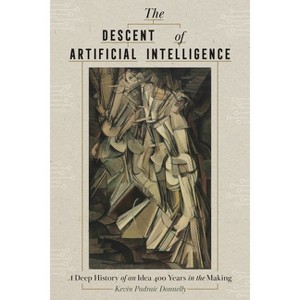
The Descent of Artificial Intelligence - by Kevin Padraic Donnelly (Hardcover)
In Stock
Sponsored
About this item
Highlights
- A 2025 Choice Outstanding Academic Title The idea that a new technology could challenge human intelligence is as old as the warning from Socrates and Plato that written language eroded memory.
- About the Author: Kevin Padraic Donnelly is an associate professor of history at Alvernia University.
- 384 Pages
- Science, Applied Sciences
Description
About the Book
A Radically Different History of AI Spanning Four Centuries of Research on Human Intelligence and Behavior
Book Synopsis
A 2025 Choice Outstanding Academic Title
The idea that a new technology could challenge human intelligence is as old as the warning from Socrates and Plato that written language eroded memory. With the emergence of generative artificial intelligence programs, we find ourselves once again debating how a new technology might influence human thought and behavior. Researchers, software developers, and "visionary" tech writers even imagine an AI that will equal or surpass human intelligence, adding to a sense of technological determinism where humanity is inexorably shaped by powerful new machines. But among the hundreds of essays, books, and movies that approach the question of AI, few have asked how exactly scientists and philosophers have codified human thought and behavior. Rather than focusing on technical contributions in machine building, The Descent of Artificial Intelligence explores a more diverse cast of thinkers who helped to imagine the very kind of human being that might be challenged by a machine. Kevin Padraic Donnelly argues that what we often think of as the "goal" of AI has in fact been shaped by forgotten and discredited theories about people and human nature as much as it has been by scientific discoveries, mathematical advances, and novel technologies. By looking at the development of artificial intelligence through the lens of social thought, Donnelly deflates the image of artificial intelligence as a technological monolith and reminds readers that we can control the narratives about ourselves.
Review Quotes
Provides valuable insight into epistemological debates central in establishing the study of human nature as a "science."-- "American Historical Review"
there is much to be learned from this thorough and erudite book-- "Technology and Culture"
The book is a valuable intervention in the rapidly expanding historical literature on the history of AI and also a useful and readable resource for students and scholars at all levels who want to know more about the historical roots of fraught contemporary discourses around intelligence, artificial or otherwise.-- "Choice"
The Descent of Artificial Intelligence is an eye-opening take on the history of AI. This is a sophisticated piece of scholarship that shows us just how strongly AI innovation is connected to our scientific fascination with people. It is a must-read for all who want to look beyond the AI hype.--Mona Sloane, University of Virginia
Confronted with the complexity of human minds and human social forms, the philosophers, economists, sociologists, and engineers whose history Donnelly traces here responded by imagining, and convincing the rest of us to imagine, that things like 'minds' and 'intelligence' and 'society' were things that social science could easily understand and measure. This is a brilliantly researched and argued book, an absolute must-read for anyone interested in understanding not only where we are today but how we got here.--Eric Hayot, Director of the Center for Humanities and Information, Penn State University
In The Descent of Artificial Intelligence, Kevin Padraic Donnelly recovers a deep history of AI, going beyond the usual emphasis on computers to focus on the ways our shifting perceptions of intelligence have, over several centuries, led some people to believe it can be modeled in ways that technology can handle. The result is an ambitious and highly readable account that puts the ongoing debates about AI in a new light.--Chris Renwick, University of York
About the Author
Kevin Padraic Donnelly is an associate professor of history at Alvernia University. His scholarship has appeared in the British Journal for the History of Science, History of Science, PUBLIC Journal, and History of Meteorology, and he has published several chapters in edited volumes on the role of statistics and science in shaping social thought. His previous book is a well-acclaimed history of the pioneering nineteenth-century statistician Adolphe Quetelet.
Shipping details
Return details
Frequently bought together






Trending Non-Fiction




Discover more options