Target New ArrivalsGift Ideas for MomClothing, Shoes & AccessoriesHome & DecorKitchen & DiningOutdoor Living & GardenGroceryHousehold EssentialsBabyBeautyPersonal CareHealthWellnessLuggageSports & OutdoorsToysElectronicsVideo GamesMovies, Music & BooksSchool & Office SuppliesParty SuppliesGift IdeasGift CardsPetsUlta Beauty at TargetShop by CommunityTarget OpticalDealsClearanceTarget New ArrivalsSpring OutfitsGift Ideas for MomWomen’s Festival OutfitsTop DealsTarget Circle DealsWeekly AdShop Order PickupShop Same Day DeliveryRegistryRedCardTarget CircleFind Stores
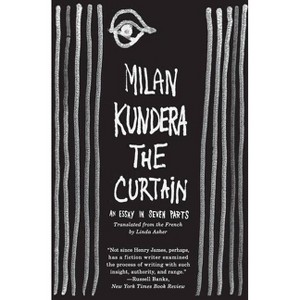
The Curtain - by  Milan Kundera (Paperback) - 1 of 1

The Curtain - by Milan Kundera (Paperback)

$12.18Save $1.81 (13% off)

In Stock

Free & easy returns

Free & easy returns

Return this item by mail or in store within 90 days for a full refund.
Eligible for registries and wish lists

About this item

Highlights

  • "An elegant, personalized integration of anecdote, analysis, scholarship, memory and speculation. . . .
  • Author(s): Milan Kundera
  • 176 Pages
  • Literary Collections, Essays

Description


About the Book


In this entertaining and stimulating essay, Kundera deftly sketches out his personal view of the history and value of the novel in Western civilization.


Book Synopsis


"An elegant, personalized integration of anecdote, analysis, scholarship, memory and speculation. . . . Not since Henry James, perhaps, has a fiction writer examined the process of writing with such insight, authority and range of reference and allusion." --Russell Banks, New York Times Book Review

"A magic curtain, woven of legends, hung before the world. Cervantes sent Don Quixote journeying and tore through the curtain. The world opened before the knight-errant in all the comical nakedness of its prose."

In this thought-provoking, endlessly enlightening, and entertaining essay on the art of the novel, renowned author Milan Kundera suggests that "the curtain" represents a ready-made perception of the world that each of us has--a pre-interpreted world. The job of the novelist, he argues, is to rip through the curtain and reveal what it hides.

Here an incomparable literary artist cleverly sketches out his personal view of the history and value of the novel in Western civilization. In doing so, he celebrates a prose form that possesses the unique ability to transcend national and language boundaries in order to reveal some previously unknown aspect of human existence.


But what is the unique knowledge only the novel can provide?


  • The Art of the Novel: Kundera's deeply personal definition of a prose form that exists to tear through the "curtain" of pre-interpreted reality.
  • A History of Forgetting: An exploration of how memory transforms and erases, and why the novel is a unique fortress against the fleeting, ghostly nature of the past.
  • Central European Modernism: A passionate defense of Kafka, Broch, and Musil, and how their antilyrical, analytical novels charted a different course for European literature.
  • Aesthetics and Existence: Why concepts like kitsch, vulgarity, and the comical are not just artistic terms but keys to understanding the human condition.


From the Back Cover


"A magic curtain, woven of legends, hung before the world. Cervantes sent Don Quixote journeying and tore through the curtain. The world opened before the knight-errant in all the comical nakedness of its prose."

In this thought-provoking, endlessly enlightening, and entertaining essay on the art of the novel, renowned author Milan Kundera suggests that "the curtain" represents a ready-made perception of the world that each of us has--a pre-interpreted world. The job of the novelist, he argues, is to rip through the curtain and reveal what it hides. Here an incomparable literary artist cleverly sketches out his personal view of the history and value of the novel in Western civilization. In doing so, he celebrates a prose form that possesses the unique ability to transcend national and language boundaries in order to reveal some previously unknown aspect of human existence.


Review Quotes


"A swiftly told, beautifully crafted, pleasurable. . . scrutiny of the novel. . . . To Mr. Kundera, the novel is a liberating force." - The Economist

"Bursting at the seams with ideas. . . Kundera dashes irrepressibly around his own studio. . . to consistently fascinating effect. A rare pleasure." - Steven Poole, New Statesman

"As the French expression goes, Kundera always gives you furiously to think...[He] writes...with passion." - Michael Dirda, Washington Post Book World

"Kundera offers witty and edifying improvisations on...favorite themes...Anyone interested in the novel will delight in this book." - Alec Solomita, New York Sun

"Well-worth reading. . . witty and brisk and very smart, like all of [Kundera's] writing." - William Deresiewicz, The Nation

"Lovely, meandering observations on the genre to which he has consecrated his life. . . . Like good love stories, it pulls you in." - Philadelphia Inquirer

"Kundera's essay so perfectly distilles an approach to art that it realigns the way an art form is understood." - Publishers Weekly (starred review)

"Essential reading in a long history of debates about the genre. . . . Wise, deep, and witty." - New York Review of Books

"A work of sophisticated literary cartography. . . agreeably studded with insights." - Wall Street Journal

"An elegant, personalized integration of anecdote, analysis, scholarship, memory and speculation. . . . Not since Henry James, perhaps, has a fiction writer examined the process of writing with such insight, authority and range of reference and allusion. . . Kundera's opinions, reflections, memories and desires are well worth listening to." - New York Times Book Review

"Brilliant, vehement, learned and wise...Stimulating and provocative...THE CURTAIN raises essential questions." - Salon.com

"Kundera...argues brilliantly...Discarding chronology, [he] lets us witness the inner workings of his....wonderful reader's mind." - Cecile Alduy, San Francisco Chronicle

"Evocative...Kundera marvelously conducts us on a journey through the history of the novel." - Library Journal

"Kundera is assuredly one of the great living writers. . . . This is a remarkable book. . . . Absorbing and sometimes sublime." - Buffalo News


Dimensions (Overall): 7.98 Inches (H) x 5.36 Inches (W) x .44 Inches (D)
Weight: .3 Pounds
Suggested Age: 22 Years and Up
Number of Pages: 176
Genre: Literary Collections
Sub-Genre: Essays
Publisher: Harper Perennial
Format: Paperback
Author: Milan Kundera
Language: English
Street Date: December 26, 2007
TCIN: 76912531
UPC: 9780060841959
Item Number (DPCI): 247-00-5603
Origin: Made in the USA or Imported
If the item details aren’t accurate or complete, we want to know about it.

Shipping details

Estimated ship dimensions: 0.44 inches length x 5.36 inches width x 7.98 inches height
Estimated ship weight: 0.3 pounds
We regret that this item cannot be shipped to PO Boxes.
This item cannot be shipped to the following locations: American Samoa (see also separate entry under AS), Guam (see also separate entry under GU), Northern Mariana Islands, Puerto Rico (see also separate entry under PR), United States Minor Outlying Islands, Virgin Islands, U.S., APO/FPO, Alaska, Hawaii

Return details

This item can be returned to any Target store or Target.com.
This item must be returned within 90 days of the date it was purchased in store, delivered to the guest, delivered by a Shipt shopper, or picked up by the guest.
See the return policy for complete information.

Q: What does the ‘curtain’ symbolize in Kundera's essay?

submitted by AI Shopping Assistant - 2 months ago
  • A: The ‘curtain’ symbolizes a pre-interpreted perception of the world that the novelist aims to uncover and challenge.

    submitted byAI Shopping Assistant - 2 months ago
    Ai generated

Q: How does Kundera define the role of a novelist?

submitted by AI Shopping Assistant - 2 months ago
  • A: He suggests that a novelist's role is to tear through preconceived notions and reveal hidden truths of reality.

    submitted byAI Shopping Assistant - 2 months ago
    Ai generated

Q: What literary style does Kundera adopt in this book?

submitted by AI Shopping Assistant - 2 months ago
  • A: He combines anecdote, analysis, scholarship, and speculation in a unique and engaging narrative style.

    submitted byAI Shopping Assistant - 2 months ago
    Ai generated

Q: What themes are explored in the essays by Milan Kundera?

submitted by AI Shopping Assistant - 2 months ago
  • A: Kundera explores themes like memory, the value of novels, and the human condition through a literary lens.

    submitted byAI Shopping Assistant - 2 months ago
    Ai generated

Q: What perspective does Kundera offer on Central European literature?

submitted by AI Shopping Assistant - 2 months ago
  • A: He passionately defends authors like Kafka and Broch, highlighting their unique contributions to European literary traditions.

    submitted byAI Shopping Assistant - 2 months ago
    Ai generated

Additional product information and recommendations

Discover more options

Trending Literary Fiction

Get top deals, latest trends, and more.

Privacy policy