Sponsored
In Stock
Sponsored
About this item
Highlights
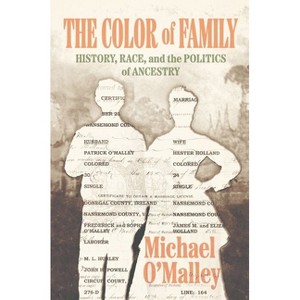
- A uniquely blended personal family history and history of the changing definitions of race in America.
- About the Author: Michael O'Malley is professor of US history at George Mason University.
- 336 Pages
- Biography + Autobiography, Cultural, Ethnic & Regional
Description
About the Book
"For endless decades, white American authorities sought to police racial boundaries and define racial identities. But that dubious enterprise was subject not just to human error but to changing concepts of race. Thus was Michael O'Malley, a descendant of a Philadelphia Irish-American family, brought to have "colored" ancestors in Virginia. The meanings of the names and relationships in the official record kept shifting in confusing and unexpected ways. O'Malley teases out how those changes affected his ancestors as they navigated what it meant to be "white," "colored," "mixed race," or anything else in America from the nineteenth century onward-even today, when digitization and privatization are changing how such racecraft manifests"--
Book Synopsis
A uniquely blended personal family history and history of the changing definitions of race in America.
A zealous eugenicist ran Virginia's Bureau of Vital Statistics in the first half of the twentieth century, misusing his position to reclassify people he suspected of hiding their "true" race. But in addition to being blinded by his prejudices, he and his predecessors were operating more by instinct than by science. Their whole dubious enterprise was subject not just to changing concepts of race but outright error, propagated across generations.
This is how Michael O'Malley, a descendant of a Philadelphia Irish American family, came to have "colored" ancestors in Virginia. In The Color of Family, O'Malley teases out the various changes made to citizens' names and relationships over the years, and how they affected families as they navigated what it meant to be "white," "colored," "mixed race," and more. In the process, he delves into the interplay of genealogy and history, exploring how the documents that establish identity came about, and how private companies like Ancestry.com increasingly supplant state and federal authorities--and not for the better.
Combining the history of O'Malley's own family with the broader history of racial classification, The Color of Family is an accessible and lively look at the ever-shifting and often poisoned racial dynamics of the United States.
Review Quotes
"Brilliantly researched, marvelously executed, and deeply unsettling."-- "Current Pub"
"Highly engaging. . . . The Color of Family is that rarity, an academic page-turner."-- "Irish Times"
"The Color of Family is at once an immediately engaging account of an Irish and Virginian family history and a compelling critique of the work of producing and policing racial categories through official records of individual identity. Through his stories and documents, O'Malley both confronts the commodification of genealogical sources and offers a profoundly important message about the fiction and effects of race."-- "Catherine Nash, author of Genetic Geographies"
"A compelling glimpse of major themes in US history through the tangled branches of one family tree. O'Malley writes beautifully in that zone where street-level, lived experience intersects with broader structures of society, ideology, and governance. This is historical writing at its best."-- "Matthew Frye Jacobson, author of Whiteness of a Different Color"
"O'Malley's Color of Family will intrigue anyone interested in genealogy, family history, or historians' methods. The many blind corners and unexpected turns in this account of a historian's genealogical research compel the reader to hold on even more tightly to O'Malley's clear and vivid storytelling."-- "Francesca Morgan, author of A Nation of Descendants"
About the Author
Michael O'Malley is professor of US history at George Mason University. He is the author of multiple books, most recently Face Value and The Beat Cop, published by the University of Chicago Press.
Shipping details
Return details
Frequently bought together



Trending Non-Fiction




Discover more options