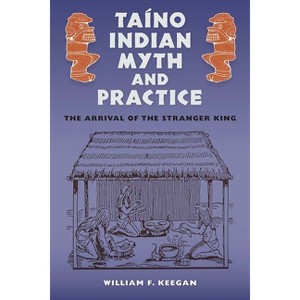
Applying the legend of the "stranger king" to Caonabo, the mythologized Taino chief of the Hispaniola settlement Columbus invaded in 1492, Keegan examines how myths come to resonate as history--created by the chaotic interactions of the individuals who lived the events of the past as well as those who write and read about them.
Author(s): William F Keegan
252 Pages
Social Science, Archaeology
Series Name: Florida Museum of Natural History: Ripley P. Bullen
Description
About the Book
"Applying the legend of the "stranger king" to Caonabo, the mythologized Taâino chief of the Hispaniola settlement Columbus invaded in 1492, Keegan examines how myths come to resonate as history -- created by the chaotic interactions of the individuals who lived the events of the past as well as those who write and read about them. The "stranger king" story told in many cultures is that of a foreigner who comes from across the water, marries the king's daughter, and deposes the king. In this story, Caonabo, the most important Taâino chief at the time of European conquest, claimed to be imbued with Taâino divinity, while Columbus, determined to establish a settlement called La Navidad, described himself as the "Christbearer." Keegan's ambitious historical analysis -- knitting evidence from Spanish colonial documents together with data gathered from the archaeological record -- provides a new perspective on the encounters between the two men as they vied for control of the settlement, a survey of the early interactions of the Taâinos and Spanish people, and a complex view of the interpretive role played by historians and archaeologists. Presenting a new theoretical framework based on chaos and complexity theories, this book argues for a more comprehensive philosophy of archaeology in which oral myths, primary source texts, and archaeological studies can work together to reconstruct a particularly rich view of the past."--Amazon.com
Book Synopsis
Applying the legend of the "stranger king" to Caonabo, the mythologized Taino chief of the Hispaniola settlement Columbus invaded in 1492, Keegan examines how myths come to resonate as history--created by the chaotic interactions of the individuals who lived the events of the past as well as those who write and read about them. The "stranger king" story told in many cultures is that of a foreigner who comes from across the water, marries the king's daughter, and deposes the king. In this story, Caonabo, the most important Taíno chief at the time of European conquest, claimed to be imbued with Taino divinity, while Columbus, determined to establish a settlement called La Navidad, described himself as the "Christbearer."
Keegan's ambitious historical analysis--knitting evidence from Spanish colonial documents together with data gathered from the archaeological record--provides a new perspective on the encounters between the two men as they vied for control of the settlement, a survey of the early interactions of the Tainos and Spanish people, and a complex view of the interpretive role played by historians and archaeologists. Presenting a new theoretical framework based on chaos and complexity theories, this book argues for a more comprehensive philosophy of archaeology in which oral myths, primary source texts, and archaeological studies can work together to reconstruct a particularly rich view of the past.
A volume in the Florida Museum of Natural History: Ripley P. Bullen Series
Review Quotes
"An excellent example of how oral traditions (mythology), historical sources, and archaeology can work together to provide richer, more complex views of the human past."--Choice
"An open-minded combination of archaeology, ethnohistory, and cultural anthropology." --Latin American Antiquity
"Explores the intersection of myths, beliefs and practices among the different participants who have written this history."--Times of the Islands
"In this bold and original study William Keegan crafts a complex narrative that combines archaeology, ethnohistory, ethnology, and linguistics to argue that a famous contact period Taino chief, Caonabo, originated from a specific impressive site, MC-6 on Middle caicos."--Journal of Anthropological Research
"Keegan's discussion of the archaeological data of the Bahamian Archipelago in relation to Hispaniola provides an excellent, updated synthesis of important work that is not well known even among Caribbeanists."--Cambridge Archaeological Journal
"Successfully synthesizes over 25 years of painstaking, innovative research and constitutes a much broader perspective on Taino myth and society than that offered by previous studies. Keegan's . . . interpretations are erudite, original, and highly provocative."--American Ethnologist
"A richly textured, deeply personal interpretation of one incident in Taino/Spanish contact relations, the capture and death of Cacique Caonabo, a principal chief of the Island of Hispaniola (now the Dominican Republic and Haiti) in 1494."--Centro Journal
"A must read for all serious scholars of Caribbean prehistory and ethnohistory. Keegan skillfully plays documentary sources against the archaeological record to reveal the complex nature of Taino-Spanish interactions and the way mythology, both Taino and Spanish, structured those relations."--New West Indian Guide
Dimensions (Overall): 9.0 Inches (H) x 6.0 Inches (W) x .53 Inches (D)
Weight: .75 Pounds
Suggested Age: 22 Years and Up
Number of Pages: 252
Genre: Social Science
Sub-Genre: Archaeology
Series Title: Florida Museum of Natural History: Ripley P. Bullen
Publisher: University Press of Florida
Format: Paperback
Author: William F Keegan
Language: English
Street Date: May 3, 2022
TCIN: 86113084
UPC: 9780813068725
Item Number (DPCI): 247-00-9053
Origin: Made in the USA or Imported
If the item details aren’t accurate or complete, we want to know about it.
Shipping details
Estimated ship dimensions: 0.53 inches length x 6 inches width x 9 inches height
Estimated ship weight: 0.75 pounds
We regret that this item cannot be shipped to PO Boxes.
This item cannot be shipped to the following locations: American Samoa (see also separate entry under AS), Guam (see also separate entry under GU), Northern Mariana Islands, Puerto Rico (see also separate entry under PR), United States Minor Outlying Islands, Virgin Islands, U.S., APO/FPO
Return details
This item can be returned to any Target store or Target.com.
This item must be returned within 90 days of the date it was purchased in store, shipped, delivered by a Shipt shopper, or made ready for pickup.