Sponsored
In Stock
Sponsored
About this item
Highlights
- While environmentalists insist that lower rates of consumption of natural resources are essential for a sustainable future, many economists dismiss the notion that resource limits act to constrain modern, creative societies.
- About the Author: Timothy F. H. Allen is a professor of botany at the University of Wisconsin, Madison.
- 440 Pages
- Science, Environmental Science
- Series Name: Complexity in Ecological Systems
Description
About the Book
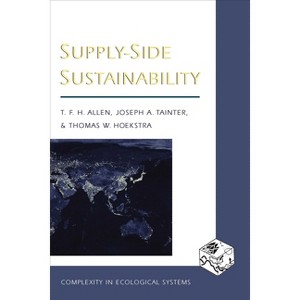
This is the first book to integrate ecological and social science in an interdisciplinary treatment of sustainability. The book explains sustainability and collapse in human societies ranging from hunter-gatherers to empires and today's industrial world.
Book Synopsis
While environmentalists insist that lower rates of consumption of natural resources are essential for a sustainable future, many economists dismiss the notion that resource limits act to constrain modern, creative societies. The conflict between these views tinges political debate at all levels and hinders our ability to plan for the future.
Supply-Side Sustainability offers a fresh approach to this dilemma by integrating ecological and social science approaches in an interdisciplinary treatment of sustainability. Written by two ecologists and an anthropologist, this book discusses organisms, landscapes, populations, communities, biomes, the biosphere, ecosystems and energy flows, as well as patterns of sustainability and collapse in human societies, from hunter-gatherer groups to empires to today's industrial world. These diverse topics are integrated within a new framework that translates the authors' advances in hierarchy and complexity theory into a form useful to professionals in science, government, and business.
The result is a much-needed blueprint for a cost-effective management regime, one that makes problem-solving efforts themselves sustainable over time. The authors demonstrate that long-term, cost-effective resource management can be achieved by managing the contexts of productive systems, rather than by managing the commodities that natural systems produce.
Review Quotes
[A] thoughtful book that reviews historical topics associated with sustainability, presents model cases of sustainable or nonsustainable future, s outlines important principles associated with ecological management of material systems, and the theoretical approaches to manage them. It will appeal to a broad audience seeking solutions to these daunting problems.--Clive A. Edwards "Quarterly Review of Biology"
Sustainability does not emerge just from activities such as recycling or conserving biodiversity; it requires problem solving. This, too, costs more and more for ever-smaller amounts of information, but Allen (botany, Univ. of Wisconsin, Madison) and Tainter and Hoekstra (both, USDA Forest Service) offer recommendations for reducing costs... the importance of how a society can become sustainable makes the effort vital.-- "Choice"
This is undoubtedly the most thought-provoking book on sustainability that has appeared so far.-- "Int'l Journal of Sustainable Development & World Economy"
Using a very wide range of examples from ecology and social history, the authors seek to show how supply-side sustainability works in both social and ecological situations. The mix of disciplines encountered here is intellectually fertile, the social and the ecological inputs illuminating one another effectively and together producing a unified approach to a complex problem.-- "British Ecological Society"
About the Author
Timothy F. H. Allen is a professor of botany at the University of Wisconsin, Madison. Joseph Tainter is a project leader at the Rocky Mountain Research Station in the USDA Forest Service in Albuquerque. Thomas W. Hoekstra is director of the Inventory and Monitoring Institute of the National Resources Research Center of the USDA Forest Service.
Shipping details
Return details
Frequently bought together





Trending Non-Fiction






Discover more options