Sponsored
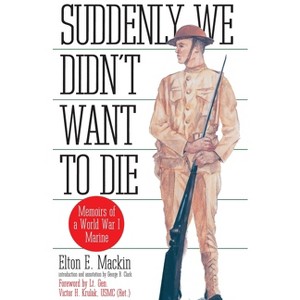
Suddenly We Didn't Want to Die - by Elton Mackin (Paperback)
In Stock
Sponsored
About this item
Highlights
- In the tradition of All Quiet on the Western Front, Elton E. Mackin's memoirs are a haunting portrayal of war as seen through the eyes of a highly decorated Marine who fought in every Marine Brigade battle from Belleau Wood to the crossing of the Meuse on the eve of the Armistice.
- About the Author: Elton E. Mackin (1898-1974) joined the Marine Corps in early 1918 and was assigned to the 1st Battalion, 5th Marine Regiment on the second day of the battle of Belleau Wood, June 7, 1928.
- 272 Pages
- History, Military
Description
About the Book
Mackin's memoirs are a haunting portrayal of war in the tradition of All Quiet on the Western Front.
Book Synopsis
In the tradition of All Quiet on the Western Front, Elton E. Mackin's memoirs are a haunting portrayal of war as seen through the eyes of a highly decorated Marine who fought in every Marine Brigade battle from Belleau Wood to the crossing of the Meuse on the eve of the Armistice.
Praise for Suddenly We Didn't Want to Die
"This beautifully written and truly gripping war memoir is a significant addition to battlefield literature. A minor classic . . . An altogether remarkable job [comparable] to Crane, Remarque and Mailer. Deserves the widest possible audience."--The Cleveland Plain Dealer
"This immediate, eloquent report merit[s] comparison with Thomas Boyd's Marine Corps [1923] classic Through the wheat."--Publishers Weekly
"A real curiosity: a highly mannered World War I diary, published nearly 80 years after being written and 20 years after its author's death. Bright snapshots abound...sometimes a young man's lyricism takes over [but] the horror of war never departs. The diary has the faults one expects, and the promise one prays for. A fine addition to WWI literature."--Kirkus Reviews
"A forthright, eloquent, and powerful memoir certain to become an enduring testament to the drama and tragedy of World War I. Threaded with no small measure of poetry, this superb memoir is sure to become a classic."--Great Battles
"A plain but powerful tale . . . [in] vivid prose loaded with details that bring the horrors of World War I to life, he tells an exceptional new version of the old story of battle transforming a boy into a veteran."--American Library Association Booklist
"To the ranks of Erich Maria Remarque, E.E. Cummings, John Dos Passos and Siegfried Sassoon, we must now add Elton Mackin . . . who, in a terse style reminiscent of Hemingway, [succeeds] in making someone unfamiliar with war truly now the frightfulness of the trenches and the greatness of the many men who fought in them."--Marine Corps Gazette
From the Back Cover
In the tradition of All Quiet on the Western Front, Elton E. Mackin's memoirs are a haunting portrayal of war as seen through the eyes of a highly decorated Marine Corps private who fought in every major World War I campaign in which the Marine Brigade participated - from Belleau Wood to the crossing of the Meuse on the eve of the Armistice. At age nineteen, Private Mackin joined the Marine Brigade's 1st Battalion, 5th Marine Regiment on beleaguered Hill 142, where the Marines were fighting as part of the U.S. Army's 2d Infantry Division. The call soon went out for volunteers to serve as runners, carrying messages from headquarters to the front lines or guiding attacking units to the jumpoff point. Mackin accepted the challenge and became a member of what frontline marines called the "suicide squad". He miraculously survived some of the most vicious fighting of the war without serious injury - other than to his psyche. His narrative, written in a style evocative of the heyday of American literature, the 1920s and 1930s, is certain to become a classic in its own right. Mackin shares with the reader not just the horrors of war, but the subtle little everyday experiences that make the life of the combat soldier both tolerable and soul-shattering. Suddenly We Didn't Want to Die is a book that will leave you wondering how anyone can emerge from battle with sanity intact.
Review Quotes
"This beautifully written and truly gripping war memoir is a significant addition to battlefield literature. A minor classic . . . An altogether remarkable job [comparable] to Crane, Remarque and Mailer. Deserves the widest possible audience."--The Cleveland Plain Dealer
"This immediate, eloquent report merit[s] comparison with Thomas Boyd's Marine Corps [1923] classic Through the wheat."--Publishers Weekly
"A real curiosity: a highly mannered World War I diary, published nearly 80 years after being written and 20 years after its author's death. Bright snapshots abound...sometimes a young man's lyricism takes over [but] the horror of war never departs. The diary has the faults one expects, and the promise one prays for. A fine addition to WWI literature."--Kirkus Reviews
"A forthright, eloquent, and powerful memoir certain to become an enduring testament to the drama and tragedy of World War I. Threaded with no small measure of poetry, this superb memoir is sure to become a classic."--Great Battles
"A plain but powerful tale . . . [in] vivid prose loaded with details that bring the horrors of World War I to life, he tells an exceptional new version of the old story of battle transforming a boy into a veteran."--American Library Association Booklist
"To the ranks of Erich Maria Remarque, E.E. Cummings, John Dos Passos and Siegfried Sassoon, we must now add Elton Mackin . . . who, in a terse style reminiscent of Hemingway, [succeeds] in making someone unfamiliar with war truly now the frightfulness of the trenches and the greatness of the many men who fought in them."--Marine Corps Gazette
About the Author
Elton E. Mackin (1898-1974) joined the Marine Corps in early 1918 and was assigned to the 1st Battalion, 5th Marine Regiment on the second day of the battle of Belleau Wood, June 7, 1928. Mackin was awarded the U.S. Army Distinguished Service Cross, the Navy Cross, and two army Silver Star citations for his valor from Octoer 3-5, 1918, at Blanc-Mont.
Shipping details
Return details
Frequently bought together





Guests also viewed

Discover more options