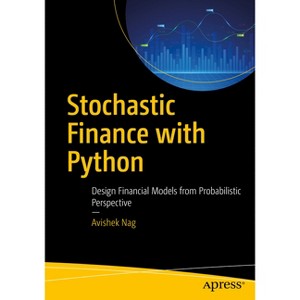
Journey through the world of stochastic finance from learning theory, underlying models, and derivations of financial models (stocks, options, portfolios) to the almost production-ready Python components under cover of stochastic finance.
About the Author: Avishek Nag has been an analytics practitioner for several years now, specializing in statistical methods, machine learning, NLP & Quantitative Finance.
396 Pages
Computers + Internet, Programming Languages
Description
Book Synopsis
Journey through the world of stochastic finance from learning theory, underlying models, and derivations of financial models (stocks, options, portfolios) to the almost production-ready Python components under cover of stochastic finance. This book will show you the techniques to estimate potential financial outcomes using stochastic processes implemented with Python.
The book starts by reviewing financial concepts, such as analyzing different asset types like stocks, options, and portfolios. It then delves into the crux of stochastic finance, providing a glimpse into the probabilistic nature of financial markets. You'll look closely at probability theory, random variables, Monte Carlo simulation, and stochastic processes to cover the prerequisites from the applied perspective. Then explore random walks and Brownian motion, essential in understanding financial market dynamics. You'll get a glimpse of two vital modelling tools used throughout the book - stochastic calculus and stochastic differential equations (SDE).
Advanced topics like modeling jump processes and estimating their parameters by Fourier-transform-based density recovery methods can be intriguing to those interested in full-numerical solutions of probability models. Moving forward, the book covers options, including the famous Black-Scholes model, dissecting it from both risk-neutral probability and PDE perspectives. A chapter at the end also covers the discovery of portfolio theory, beginning with mean-variance analysis and advancing to portfolio simulation and the efficient frontier.
What You Will Learn
Understand applied probability and statistics with finance
Design forecasting models of the stock price with the stochastic process, Monte-Carlo simulation.
Option price estimation with both risk-neutral probabilistic and PDE-driven approach.
Use Object-oriented Python to design financial models with reusability.
Who This Book Is For
Data scientists, quantitative researchers and practitioners, software engineers and AI architects interested in quantitative finance
From the Back Cover
Journey through the world of stochastic finance from learning theory, underlying models, and derivations of financial models (stocks, options, portfolios) to the almost production-ready Python components under cover of stochastic finance. This book will show you the techniques to estimate potential financial outcomes using stochastic processes implemented with Python.
The book starts by reviewing financial concepts, such as analyzing different asset types like stocks, options, and portfolios. It then delves into the crux of stochastic finance, providing a glimpse into the probabilistic nature of financial markets. You'll look closely at probability theory, random variables, Monte Carlo simulation, and stochastic processes to cover the prerequisites from the applied perspective. Then explore random walks and Brownian motion, essential in understanding financial market dynamics. You'll get a glimpse of two vital modelling tools used throughout the book - stochastic calculus and stochastic differential equations (SDE).
Advanced topics like modeling jump processes and estimating their parameters by Fourier-transform-based density recovery methods can be intriguing to those interested in full-numerical solutions of probability models. Moving forward, the book covers options, including the famous Black-Scholes model, dissecting it from both risk-neutral probability and PDE perspectives. A chapter at the end also covers the discovery of portfolio theory, beginning with mean-variance analysis and advancing to portfolio simulation and the efficient frontier.
About the Author
Avishek Nag has been an analytics practitioner for several years now, specializing in statistical methods, machine learning, NLP & Quantitative Finance. He has experience designing end-to-end Machine Learning systems and driving Data Science/ML initiatives from inception to production in multiple organizations (Cisco, VMware, Mobile Iron, etc.). A few years of experience in the commodity trading domain inspired him to write this book. He has also authored other books on machine learning & survival analysis, respectively. His Data science & ML-related blogs can be found on Medium (@avisheknag17).
Besides his work, he is also a passionate artist who loves to explore architectural drawings through pencil and ink. Samples of his artwork can be found on Instagram(/avisheknag17), Artquid.com(artquid.com/avishekarts), and many other art platforms.
Dimensions (Overall): 10.0 Inches (H) x 7.0 Inches (W) x .84 Inches (D)
Weight: 1.57 Pounds
Suggested Age: 22 Years and Up
Sub-Genre: Programming Languages
Genre: Computers + Internet
Number of Pages: 396
Publisher: Apress
Theme: Python
Format: Paperback
Author: Avishek Nag
Language: English
Street Date: December 14, 2024
TCIN: 1002293794
UPC: 9798868810510
Item Number (DPCI): 247-36-1887
Origin: Made in the USA or Imported
If the item details aren’t accurate or complete, we want to know about it.
Shipping details
Estimated ship dimensions: 0.84 inches length x 7 inches width x 10 inches height
Estimated ship weight: 1.57 pounds
We regret that this item cannot be shipped to PO Boxes.
This item cannot be shipped to the following locations: American Samoa (see also separate entry under AS), Guam (see also separate entry under GU), Northern Mariana Islands, Puerto Rico (see also separate entry under PR), United States Minor Outlying Islands, Virgin Islands, U.S., APO/FPO, Alaska, Hawaii
Return details
This item can be returned to any Target store or Target.com.
This item must be returned within 90 days of the date it was purchased in store, delivered to the guest, delivered by a Shipt shopper, or picked up by the guest.