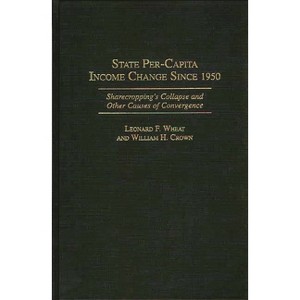
This book refutes prevailing theories that attribute post-1950 state per capita income convergence to (1) neo-classical adjustment mechanisms, (2) institutional sclerosis, and (3) southern industrialization.
About the Author: LEONARD F. WHEAT is an economist with the Economic Development Administration of the U.S. Department of Commerce.
200 Pages
Business + Money Management, Economics
Series Name: Contributions in Economics and Economic History
Description
About the Book
This book refutes prevailing theories that attribute post-1950 state per capita income convergence to (1) neo-classical adjustment mechanisms, (2) institutional sclerosis, and (3) southern industrialization. Wheat and Crown argue that southern income was low because of slavery's legacy--sharecropping, agricultural dependence, low urbanization, poor education, high Black population percentages, and low wage rates. The legacy's dominant feature was the sharecropper-tenant farmer system, which replaced slavery. Sharecropping was the foundation of southern poverty. Sharecropping's collapse, beginning around 1950, affected all of the other features of slavery's legacy. For example, millions of sharecroppers out-migrated from the South, shifting poverty to the North and lowering the South's Black percentage. This out-migration, white in-migration, and the civil rights movement jointly raised educational attainment in the South, further boosting southern income. Southern industrialization had only a marginally significant effect. In 1950's high income region, the West, the transport cost element in the price of manufactured goods shrank because of (1) transportation improvements and (2) rapid manufacturing growth, which reduced the need for long distance imports from the Manufacturing Belt. The resulting decline in the West's relative cost of living led to wage adjustments. Consequently, the West--despite having the highest manufacturing growth rates--had the nation's lowest per-capita income growth rates. Agricultural decline and educational gains stimulated income growth in the Plains. Nationally, per-capita employment gains were a strong influence.
Book Synopsis
This book refutes prevailing theories that attribute post-1950 state per capita income convergence to (1) neo-classical adjustment mechanisms, (2) institutional sclerosis, and (3) southern industrialization. Wheat and Crown argue that southern income was low because of slavery's legacy--sharecropping, agricultural dependence, low urbanization, poor education, high Black population percentages, and low wage rates. The legacy's dominant feature was the sharecropper-tenant farmer system, which replaced slavery. Sharecropping was the foundation of southern poverty. Sharecropping's collapse, beginning around 1950, affected all of the other features of slavery's legacy. For example, millions of sharecroppers out-migrated from the South, shifting poverty to the North and lowering the South's Black percentage. This out-migration, white in-migration, and the civil rights movement jointly raised educational attainment in the South, further boosting southern income. Southern industrialization had only a marginally significant effect. In 1950's high income region, the West, the transport cost element in the price of manufactured goods shrank because of (1) transportation improvements and (2) rapid manufacturing growth, which reduced the need for long distance imports from the Manufacturing Belt. The resulting decline in the West's relative cost of living led to wage adjustments. Consequently, the West--despite having the highest manufacturing growth rates--had the nation's lowest per-capita income growth rates. Agricultural decline and educational gains stimulated income growth in the Plains. Nationally, per-capita employment gains were a strong influence.
Review Quotes
.,."informative and challenging work."-Choice
?...informative and challenging work.?-Choice
?[A] literate and well informed book concerning one of the most dramatic stages in the long, arduous economic journey of the U.S. South.?-Journal of Regional Sciences
"ÝA¨ literate and well informed book concerning one of the most dramatic stages in the long, arduous economic journey of the U.S. South."-Journal of Regional Sciences
..."informative and challenging work."-Choice
"[A] literate and well informed book concerning one of the most dramatic stages in the long, arduous economic journey of the U.S. South."-Journal of Regional Sciences
About the Author
LEONARD F. WHEAT is an economist with the Economic Development Administration of the U.S. Department of Commerce.
WILLIAM H. CROWN is Associate Professor at Brandeis University.
Both have published extensively on topics in regional economics.
Dimensions (Overall): 9.21 Inches (H) x 6.14 Inches (W) x .5 Inches (D)
Weight: 1.0 Pounds
Suggested Age: 22 Years and Up
Number of Pages: 200
Genre: Business + Money Management
Sub-Genre: Economics
Series Title: Contributions in Economics and Economic History
Publisher: Praeger
Theme: Macroeconomics
Format: Hardcover
Author: Leonard F Wheat & William H Crown
Language: English
Street Date: November 20, 1995
TCIN: 1005058532
UPC: 9780313296949
Item Number (DPCI): 247-28-5537
Origin: Made in the USA or Imported
If the item details aren’t accurate or complete, we want to know about it.
Shipping details
Estimated ship dimensions: 0.5 inches length x 6.14 inches width x 9.21 inches height
Estimated ship weight: 1 pounds
We regret that this item cannot be shipped to PO Boxes.
This item cannot be shipped to the following locations: American Samoa (see also separate entry under AS), Guam (see also separate entry under GU), Northern Mariana Islands, Puerto Rico (see also separate entry under PR), United States Minor Outlying Islands, Virgin Islands, U.S., APO/FPO
Return details
This item can be returned to any Target store or Target.com.
This item must be returned within 90 days of the date it was purchased in store, shipped, delivered by a Shipt shopper, or made ready for pickup.