Sponsored
In Stock
Sponsored
About this item
Highlights
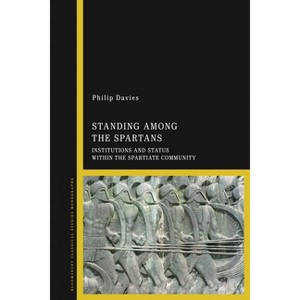
- Conformity, uniformity, institutionality, exceptionality - each of these terms encapsulates an aspect of the common perception of Sparta, both among scholars and in the popular imagination.
- About the Author: Philip John Victor Davies is Assistant Professor in Greek History at the University of Nottingham, UK.
- 208 Pages
- History, Ancient
Description
About the Book
"Drawing upon recent scholarship on Sparta, theoretical and methodological discussions from within the wider fields of classical studies and ancient history, and approaches to status and institutions developed in the social sciences, Philip John Victor Davies examines the diverse factors which influenced the standing of individuals within the Spartiate community and assesses how great a role institutions played in determining a Spartiate's standing and to what extent Sparta was, as ancient accounts would suggest, significantly more institutionalized than other Greek societies"--
Book Synopsis
Conformity, uniformity, institutionality, exceptionality - each of these terms encapsulates an aspect of the common perception of Sparta, both among scholars and in the popular imagination.
This volume seeks to interrogate how rightly we may apply these terms to the Spartan citizen community in the classical period (approximately 500-350 BC) and reveals a much greater level of differentiation within this social group than is often assumed.
Drawing upon recent scholarship on Sparta, theoretical and methodological discussions from within the wider fields of classical studies and ancient history, and approaches to status and institutions developed in the social sciences, Philip John Victor Davies examines the diverse factors which influenced the standing of individuals within the Spartiate community and assesses how great a role institutions played in determining a Spartiate's standing and to what extent Sparta was, as ancient accounts would suggest, significantly more institutionalized than other Greek societies. Placing Sparta in the context of the renewed interest in institutions and their social significance represented across multiple disciplines by the 'New Institutionalist turn', he presents a more dynamic understanding of the internal life of the Spartiate community, with a nuanced appreciation of the dimensions and limits of Sparta's exceptionality.
Review Quotes
"This learned, sober-minded and balanced approach to some of the most difficult questions on the constitution and institutions of classical Sparta is a most welcome addition to the scholarship on Sparta." --Konstantinos Kapparis, Professor of Classics, University of Florida, USA
"The volume succeeds in demonstrating that classical Spartan institutions provided both opportunities for recognition and arenas of contestation...By systematically analysing the role of major Spartan institutions ...and by extending the analysis towomen, perioikoi and 'inferior' strata, D. offers a compelling account of how standing wasstructured and perceived within the Spartan polis." --Classical Review
About the Author
Philip John Victor Davies is Assistant Professor in Greek History at the University of Nottingham, UK.
Shipping details
Return details
Frequently bought together






Trending Non-Fiction






Discover more options