Sponsored
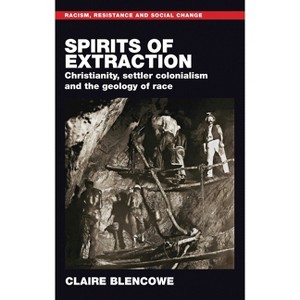
Spirits of Extraction - (Racism, Resistance and Social Change) by Claire Blencowe (Hardcover)
In Stock
Sponsored
About this item
Highlights
- An exploration of the historical intersections of the mining industry, Methodist evangelical Christianity, civilisational education, and the modern metaphysics of race.
- About the Author: Claire Blencowe is Professor of Sociology at the University of Warwick
- 240 Pages
- Social Science, Sociology
- Series Name: Racism, Resistance and Social Change
Description
About the Book
An exploration of the historical intersections of the mining industry, Methodist evangelical Christianity, civilisational education, and the modern metaphysics of race.
Book Synopsis
An exploration of the historical intersections of the mining industry, Methodist evangelical Christianity, civilisational education, and the modern metaphysics of race. Contributing to theories of race and racism by insisting on the enduring role of religious biopolitics and Christianising education, whilst expanding on the 'geology of race'.
From the Back Cover
Spirits of extraction reexamines the entangled histories of racism, Christianity, and humanitarian biopolitics in the long nineteenth century, offering a fresh perspective on the intersection of extractive industries, evangelical revivalism, and the violent civilisational metaphysics of race. Moving across eighteenth-century industrialising Bristol, the Cornish mining diaspora of the expanding British Empire, and the contested lands of Anishinaabewaki/Upper Canada/Ontario, this book traces how evangelical Christianity helped shape the colonial world through processes of extraction - of resources, bodies, and souls.
Blending historical narrative with critical theory, the book makes two key interventions. Firstly, it repositions colonial religion and educational/cultural racism as central to the biopolitical project, analysing the wounding effects of 'truly Christian' education and exorcism in evangelical subject formation. Secondly, it extends thinking on the 'geology of race' by highlighting the extractive industries as the affective scene through which modern evangelical Christianity came to life. By showing how mining and missionary practices co-constituted racial hierarchies and modes of sovereignty, Spirits of extraction offers a major contribution to thinking about the politics of life and resource extraction. Evangelical experiences of salvation, exorcism, and the transformative power of faith, the book argues, resonate through geological consciousness and the logics of extraction, sustaining a quasi-divine force that continues to structure lives and landscapes today.
Review Quotes
'In this critically important and theoretically daring book, Claire Bencowe takes us on a journey through places that appear disconnected yet are deeply entangled. She skilfully traces links between her own situated history within colonial webs of extraction, the rise of Methodism in Bristol and the UK, Cornish miners and migrants, and residential schools on Indigenous lands in Canada. Beautifully written, the book grounds the concept of a 'geology of race' with audacity, making it an essential guide for anyone seeking to understand the entanglements of planetary extraction, Christianity and British colonialism.'
Dr Negar Elodie Behzadi, Editor of Extraction/Exclusion: Beyond Binaries of Exclusion and Inclusion in Natural Resource Extraction (Bloomsbury, 2024)
'Christianity, Settler Colonialism and the Geology of Race is compact in form but expansive in scope. It brings together theology, political economy, and the lived realities of migration and extraction in a way that challenges any neat separation between religious history, the metaphysics of racism, and colonial capitalism, showing how Methodism underpinned the genocidal destruction of Indigenous peoples and their rights to land, rocks, animals, and ancestral spirits, while simultaneously policing Cornish miners to prevent them from turning to alcohol. The prose is lucid, the research meticulous, and the argument both unsettling and necessary.'
Özge Onay, Ethnic and Racial Studies
'The role of religiously charged racism does indeed demand sustained critical attention, not least where and when it fused with other powerful forces that have damaged and decimated human communities and cultures. Blencowe's hard-hitting book is a welcome addition to this necessary critical endeavour.'
Diarmid A. Finnegan, Journal of Historical Geography
'Moving from Bristol and Cornwall to Australia, Africa and the Americas, this book tells a transnational story of racism and cruelty, underpinned by 'good intentions' and desire for redemption. Whether it is Bristol city council' attempt to move on from its history of slavery, Methodist clerics' management of residential schools, or the exclusionary labour policies of Cornish miners who were themselves racialised as 'Blackened', Claire Blencowe shows how even groups opposed to, and marginalised, by empire inflicted colonial violence onto Indigenous populations. At its core, the book asks whether race and not class functions as the primary means of socio-economic oppression.'
Dr. Angela Last, International Research Fellow (University of Bonn)
'The book powerfully demonstrates how material extraction - of minerals, labour, and land - was inextricably linked to the racialised Christianising and colonial orders that shaped modernity. Its greatest strength lies in tracing the temporal depth and spatial reach of these entanglements, connecting Britain's industrial heartlands to its settler colonies overseas.'
Mitsutoshi Horii, Journal of Political Power
About the Author
Claire Blencowe is Professor of Sociology at the University of Warwick
Shipping details
Return details
Frequently bought together


Trending Non-Fiction






Discover more options