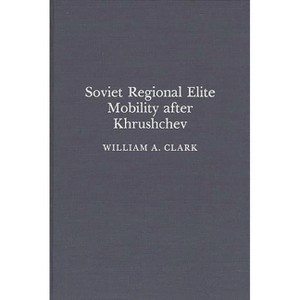
Clark's groundbreaking study covers the period in Soviet political history from the fall of Nikita Khrushchev in late 1964 through the spring of 1987 and examines the forces affecting regional elite mobility throughout the Soviet Union during these years.
About the Author: WILLIAM A. CLARK is Associate Director of the James F. Byrnes International Center and teaches in the Department of Government and International Studies at the University of South Carolina.
217 Pages
Social Science, Social Classes & Economic Disparity
Series Name: Contributions to the Study of Childhood
Description
About the Book
Clark's groundbreaking study covers the period in Soviet political history from the fall of Nikita Khrushchev in late 1964 through the spring of 1987 and examines the forces affecting regional elite mobility throughout the Soviet Union during these years. Turning the explanatory focus away from the traditional areas of patronage and clientelism, Clark adopts a novel approach to the subject by concentrating on structural variables such as the economic, social, and demographic aspects of the regions themselves as key elements of an explanation for long-term mobility trends. In addition to his focus on non-traditional variables, the broad chronological scope of the study and the fact that all Soviet republics with equivalent party structures are examined make Clark's work especially valuable for graduate students and scholars of Soviet politics and government seeking a more general and inclusive explanation of regional elite mobility than has been available in previous studies of the subject.
The study is based on an exhaustive examination of the careers of over 275 Obkom (regional party committees) First Secretaries. As a result of this analysis, the 129 regional party structures of the USSR are ranked hierarchically with respect to political mobility. Throughout the study, Clark seeks to isolate non-idiosyncratic variables to explain the significant variance in mobility opportunities offered by the various regional party units. Thus, rather than relying on the traditional personalistic variables, Clark seeks to identify independent variables that have explanatory value throughout the Soviet system. Finally, Clark examines the effects of background characteristics and functional career types on elite mobility at the Obkom tier, and analyzes changes in regional cadres policy after Brezhnev. Six appendices provide additional information for the student and researcher.
Book Synopsis
Clark's groundbreaking study covers the period in Soviet political history from the fall of Nikita Khrushchev in late 1964 through the spring of 1987 and examines the forces affecting regional elite mobility throughout the Soviet Union during these years. Turning the explanatory focus away from the traditional areas of patronage and clientelism, Clark adopts a novel approach to the subject by concentrating on structural variables such as the economic, social, and demographic aspects of the regions themselves as key elements of an explanation for long-term mobility trends. In addition to his focus on non-traditional variables, the broad chronological scope of the study and the fact that all Soviet republics with equivalent party structures are examined make Clark's work especially valuable for graduate students and scholars of Soviet politics and government seeking a more general and inclusive explanation of regional elite mobility than has been available in previous studies of the subject.
The study is based on an exhaustive examination of the careers of over 275 Obkom (regional party committees) First Secretaries. As a result of this analysis, the 129 regional party structures of the USSR are ranked hierarchically with respect to political mobility. Throughout the study, Clark seeks to isolate non-idiosyncratic variables to explain the significant variance in mobility opportunities offered by the various regional party units. Thus, rather than relying on the traditional personalistic variables, Clark seeks to identify independent variables that have explanatory value throughout the Soviet system. Finally, Clark examines the effects of background characteristics and functional career types on elite mobility at the Obkom tier, and analyzes changes in regional cadres policy after Brezhnev. Six appendices provide additional information for the student and researcher.
About the Author
WILLIAM A. CLARK is Associate Director of the James F. Byrnes International Center and teaches in the Department of Government and International Studies at the University of South Carolina. Clark has published in the areas of regional elite mobility and Soviet leadership transition. His current research activity relates to the impact of subnational actors in Soviet politics.
Dimensions (Overall): 9.21 Inches (H) x 6.14 Inches (W) x .56 Inches (D)
Weight: 1.08 Pounds
Suggested Age: 22 Years and Up
Number of Pages: 217
Genre: Social Science
Sub-Genre: Social Classes & Economic Disparity
Series Title: Contributions to the Study of Childhood
Publisher: Praeger
Format: Hardcover
Author: Wiliam A Clark
Language: English
Street Date: July 21, 1989
TCIN: 1007423084
UPC: 9780275931247
Item Number (DPCI): 247-17-4180
Origin: Made in the USA or Imported
If the item details aren’t accurate or complete, we want to know about it.
Shipping details
Estimated ship dimensions: 0.56 inches length x 6.14 inches width x 9.21 inches height
Estimated ship weight: 1.08 pounds
We regret that this item cannot be shipped to PO Boxes.
This item cannot be shipped to the following locations: American Samoa (see also separate entry under AS), Guam (see also separate entry under GU), Northern Mariana Islands, Puerto Rico (see also separate entry under PR), United States Minor Outlying Islands, Virgin Islands, U.S., APO/FPO
Return details
This item can be returned to any Target store or Target.com.
This item must be returned within 90 days of the date it was purchased in store, shipped, delivered by a Shipt shopper, or made ready for pickup.