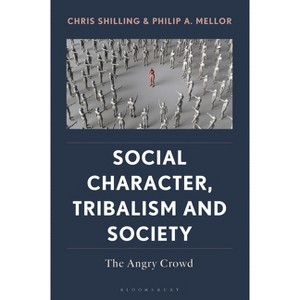
Chris Shilling and Philip A. Mellor argue that recent developments in social character are key to explaining the sectarian tribalism that has afflicted American and European societies in recent decades.Building upon one of the most influential books of the twentieth century, David Riesman's The Lonely Crowd, the authors explore the social and economic conditions that have resulted in a 'thinning' of empathy and mutual identification, the significance of inequalities and social movements in stimulating the emergence of identity-directedness, and the opportunity-directed exploitation of dynamic social change, risk and uncertainty.
About the Author: Chris Shilling is emeritus professor of sociology at the University of Kent.
200 Pages
Social Science, Sociology
Description
About the Book
Building upon David Riesman's The Lonely Crowd, the authors explore the social and economic conditions that have resulted in a 'thinning' of empathy and mutual identification.
Book Synopsis
Chris Shilling and Philip A. Mellor argue that recent developments in social character are key to explaining the sectarian tribalism that has afflicted American and European societies in recent decades. Building upon one of the most influential books of the twentieth century, David Riesman's The Lonely Crowd, the authors explore the social and economic conditions that have resulted in a 'thinning' of empathy and mutual identification, the significance of inequalities and social movements in stimulating the emergence of identity-directedness, and the opportunity-directed exploitation of dynamic social change, risk and uncertainty. Reflecting on an era marked by intensifying conflict, Social Character, Tribalism and Society asks whether it is possible that a 'saving remnant' could emerge from the characterological struggle that is fraying the social fabric and threatening to destabilise social order.
Review Quotes
Shilling and Mellor have produced a robust and scholarly analysis that makes a vital contribution to our understanding of contemporary social character and its discontents. Creatively extending Riesman's classic thesis, they help make sense of an array of contemporary developments-from the quantified self to the 'echo chamber' of social media. Their identification of identity-oriented and opportunity-oriented characterological forms provides compelling new theoretical tools for understanding late-modernity. This is a polemical but painstakingly balanced study-wide-ranging in its insights, far-reaching in its implications. Like The Lonely Crowd before it, this book is sure to become essential reading that will guide national conversations about trajectories of social development. Jason Hughes, University of Leicester; author of Norbert Elias and Modern Sociology
This is a book for our times. The twenty-first century has seen big shifts in how people live, think, feel and steer their behavior. This book explains why. And, though not a political book, it helps to answer the question of the age: how was Trump possible? Stephen Mennell, professor emeritus, University College Dublin
Using a deceptively simple definition of social character as those qualities that we-large aggregates of people-share, Shilling and Mellor build on the mid-twentieth century scholarship that sought to understand how socio-historical changes were reconfiguring characterological types. The authors return to these concerns seven decades later, engaging in particular with David Riesman's seminal work and going beyond by introducing two new types: identity direction and opportunity direction. Addressing a far-ranging array of topics, the authors explore complex issues with an admirably pellucid style. Wearing their erudition lightly, they offer brilliant insights while raising hard questions. Like The Lonely Crowd, this book deserves to be embraced by the sociological community and read widely by the general public. Peter Kivisto, Richard A. Swanson Professor of Social Thought, Emeritus, Augustana College
About the Author
Chris Shilling is emeritus professor of sociology at the University of Kent. Philip A. Mellor is professor of religion and social theory at the University of Leeds.
Dimensions (Overall): 9.0 Inches (H) x 6.0 Inches (W) x .5 Inches (D)
Weight: .96 Pounds
Suggested Age: 22 Years and Up
Number of Pages: 200
Genre: Social Science
Sub-Genre: Sociology
Publisher: Bloomsbury Academic
Theme: General
Format: Hardcover
Author: Chris Shilling & Philip A Mellor
Language: English
Street Date: October 30, 2025
TCIN: 1008786644
UPC: 9781666972863
Item Number (DPCI): 247-34-1933
Origin: Made in the USA or Imported
If the item details aren’t accurate or complete, we want to know about it.
Shipping details
Estimated ship dimensions: 0.5 inches length x 6 inches width x 9 inches height
Estimated ship weight: 0.96 pounds
We regret that this item cannot be shipped to PO Boxes.
This item cannot be shipped to the following locations: American Samoa (see also separate entry under AS), Guam (see also separate entry under GU), Northern Mariana Islands, Puerto Rico (see also separate entry under PR), United States Minor Outlying Islands, Virgin Islands, U.S., APO/FPO
Return details
This item can be returned to any Target store or Target.com.
This item must be returned within 90 days of the date it was purchased in store, shipped, delivered by a Shipt shopper, or made ready for pickup.