Sponsored
In Stock
Sponsored
About this item
Highlights
- Based on extensive fieldwork in the community of the Eastern Band of Cherokee Indians in western North Carolina, this book uses a semiotic approach to investigate the historic and contemporary role of the Sequoyan syllabary -- the written system for representing the sounds of the Cherokee language -- in Eastern Cherokee life.The Cherokee syllabary was invented in the 1820s by the respected Cherokee Sequoyah.
- Author(s): Margaret Bender
- 208 Pages
- Social Science, Anthropology
Description
About the Book
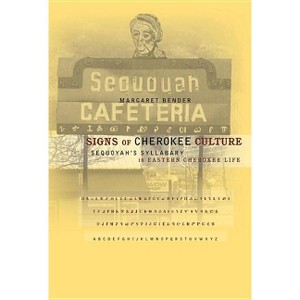
Signs of Cherokee Culture: Sequoyah's Syllabary in Eastern Cherokee Life
Book Synopsis
Based on extensive fieldwork in the community of the Eastern Band of Cherokee Indians in western North Carolina, this book uses a semiotic approach to investigate the historic and contemporary role of the Sequoyan syllabary -- the written system for representing the sounds of the Cherokee language -- in Eastern Cherokee life.
The Cherokee syllabary was invented in the 1820s by the respected Cherokee Sequoyah. The syllabary quickly replaced alternative writing systems for Cherokee and was reportedly in widespread use by the mid-nineteenth century. After that, literacy in Cherokee declined, except in specialized religious contexts. But as Bender shows, recent interest in cultural revitalization among the Cherokees has increased the use of the syllabary in education, publications, and even signage.
Bender also explores the role played by the syllabary within the ever more important context of tourism. (The Eastern Cherokee Band hosts millions of visitors each year in the Great Smoky Mountains.) English is the predominant language used in the Cherokee community, but Bender shows how the syllabary is used in special and subtle ways that help to shape a shared cultural and linguistic identity among the Cherokees. Signs of Cherokee Culture thus makes an important contribution to the ethnographic literature on culturally specific literacies.
Review Quotes
"Bender's thoughtful book sets a new standard for literacy studies among American Indians. . . . [It] raises a host of fascinating questions that should send anthropologists to the field and historians to the archives." -- Claudio Saunt, University of Georgia, for American Anthropologist
"Margaret Bender's work is dense in theory, yet easily understood when she presents supporting ethnographic data. Signs of Cherokee Culture illustrates the tenacity of the Cherokee to keep their culture and identity, defines the role and significance of the Sequoya syllabary, and adds an important volume on Native American literacy to the anthropologic literature." -- James A. Bird, Cultural Resources Manager, Eastern Band of Cherokee Indians
"Provides a detailed explanation of the historical and contemporary uses and meaning of Sequoyah's syllabary."-Our State
Shipping details
Return details
Frequently bought together





Trending Non-Fiction






Discover more options