Sponsored
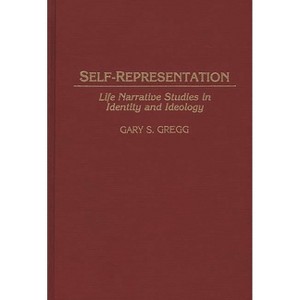
Self-Representation - International Contributions in Psychology by Gary S Gregg Hardcover
In Stock
Sponsored
About this item
Highlights
- This innovative work offers a new approach to the study of self-representation, drawing on both the older study of lives tradition in personality psychology and recent work in narrative psychology.
- About the Author: GARY S. GREGG is a personality psychologist, currently a visiting scholar at the Center for Middle Eastern Studies at Harvard University, where he is translating and analyzing life-history interviews he conducted in southern Morocco.
- 248 Pages
- Psychology, Personality
- Series Name: International Contributions in Psychology
Description
About the Book
This innovative work offers a new approach to the study of self-representation, drawing on both the older study of lives tradition in personality psychology and recent work in narrative psychology. Gary S. Gregg presents a generative theory of self-representation, applying methods of symbolic analysis developed by cultural anthropologists to the texts of life-historical interviews. This model accounts for the continual shifting of identity among contradictory surface discourses about the self, as it shows how each discourse is defined as a reconfiguration of a stable cluster of deep structurally-ambigious elements. Gregg not only examines the nature of narrative, but also addresses more mainstream issues in cognitive science, such as: How is knowledge of the self and its social world represented? What are the elementary units of self-cognition? How are cognition and affect linked?
After a brief introduction, the book raises critical questions about self-representation by presenting re-analyses of two famous case studies--Freud's Rat Man and Mack and Larry from The Authoritarian Personality--and initial observations from Gregg's fieldwork in Morocco. A theoretical chapter then introduces the notion of structured ambiguity, which enables a person to shift between identities by figure or ground-like reversals of key symbols and metaphors. Three original life-narrative analyses follow, which, with increasing complexity, develop the model via analogies to basic structures of tonal music. The work concludes with a theoretical chapter that reexamines the ideas of William James, George Herbert Mead, and Erik Erikson about the self's unity and multiplicity, and then summarizes a generative model. The book presents a compelling alternative to prevailing views of self-cognition and identity, and will be a valuable resource for courses in psychology, anthropology, and sociology, as well as an important tool for researchers and professionals in these fields.
Book Synopsis
This innovative work offers a new approach to the study of self-representation, drawing on both the older study of lives tradition in personality psychology and recent work in narrative psychology. Gary S. Gregg presents a generative theory of self-representation, applying methods of symbolic analysis developed by cultural anthropologists to the texts of life-historical interviews. This model accounts for the continual shifting of identity among contradictory surface discourses about the self, as it shows how each discourse is defined as a reconfiguration of a stable cluster of deep structurally-ambigious elements. Gregg not only examines the nature of narrative, but also addresses more mainstream issues in cognitive science, such as: How is knowledge of the self and its social world represented? What are the elementary units of self-cognition? How are cognition and affect linked?
After a brief introduction, the book raises critical questions about self-representation by presenting re-analyses of two famous case studies--Freud's Rat Man and Mack and Larry from The Authoritarian Personality--and initial observations from Gregg's fieldwork in Morocco. A theoretical chapter then introduces the notion of structured ambiguity, which enables a person to shift between identities by figure or ground-like reversals of key symbols and metaphors. Three original life-narrative analyses follow, which, with increasing complexity, develop the model via analogies to basic structures of tonal music. The work concludes with a theoretical chapter that reexamines the ideas of William James, George Herbert Mead, and Erik Erikson about the self's unity and multiplicity, and then summarizes a generative model. The book presents a compelling alternative to prevailing views of self-cognition and identity, and will be a valuable resource for courses in psychology, anthropology, and sociology, as well as an important tool for researchers and professionals in these fields.
Review Quotes
"This unique contribution to the psychology of personality is the most exciting reading in the field that I have encountered in a long time. . . . Gary Gregg has made a substantial contribution here to a humanistic psychology of interpretation, meaning, and value--but in a vein that can be conjoined with a scientific, explanatory psychology. . . . The result is breath-taking."-M. Brewster Smith Stevenson College University of California, Santa Cruz
?. . . this is an exceptional book that represents an audacious attempt to arrive at an integrative, structural theory of the self, which builds on both classical sources and significant trends in contemporary psychology and anthropology.?-Contemporary Psychology
." . . this is an exceptional book that represents an audacious attempt to arrive at an integrative, structural theory of the self, which builds on both classical sources and significant trends in contemporary psychology and anthropology."-Contemporary Psychology
About the Author
GARY S. GREGG is a personality psychologist, currently a visiting scholar at the Center for Middle Eastern Studies at Harvard University, where he is translating and analyzing life-history interviews he conducted in southern Morocco.
Shipping details
Return details
Trending Non-Fiction