Sponsored
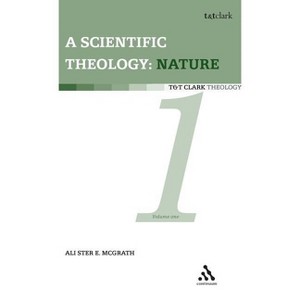
Scientific Theology: Nature - by Alister E McGrath (Hardcover)
In Stock
Sponsored
About this item
Highlights
- New in paperback of the first volume of McGrath's groundbreaking three volume work of Systematic Theology, "A Scientific Theology".
- About the Author: Alister McGrath is Professor of Historical Theology at Oxford University, UK, and the first Director of the newly-established Oxford Centre for Evangelism and Apologetics.
- 352 Pages
- Religion + Beliefs, Christian Theology
Description
About the Book
A Scientific Theology is a groundbreaking work of systematic theology in three volumes: Nature, Reality and Theory. Now available as a three volume set.
Book Synopsis
New in paperback of the first volume of McGrath's groundbreaking three volume work of Systematic Theology, "A Scientific Theology". Written by one of world's best-known theologians, these volumes together represent the most extended and systematic exploration of the relation beween Christian theology and the natural sciences yet produced. Thoroughly ecumenical, this will be a significant work for Catholic, Orthodox, Protestant and evangelical readers. The work is marked throughout by a sustained and critical engagment with the history and philosophy of the natural sciences, and a passionate commitment to the legitimacy of theology as an academic discipline.
"Nature" sets out a vision for a "scientific theology", in which the working assumptions of the natural sciences are critically appropriated as a theological resource. It then moves on to deal at considerable length with the crucially important question of the status of nature, which ahs rearely been given the serious considertion that it deserves. Responding sympathetically to the growing consensus that "nature" is a socially mediated concept, McGrath sets out an approach to nature that establishes it as a theologically legitamate notion, and explores its positive and constructive role within a scientific theology.
Review Quotes
"Professor McGrath explores a difficulty that follows from the widely held view that "nature," as with "culture," is a social construct. The prlgem is that there can then be no neutral concep of "nature" to servce as the basis of an autonomous and effective apologia. Taking his inspiration from Thomas Torrance's understanding of Karl Barth, he contends that there can be a defensible natural theology within the scope and framework of a revealed knowedge of god. Where "nature" is already read as a work of creation it takes on meanings that may be consonant with the affirmation of an order that is ultimately presupposed in the sciences. This is a serious arguement that commands attention." --Sanford Lakoff
McGrath's book attempts to identify and resolve some primary issues at the centre not only of the conversation between theology and the natural sciences but also of the Christian doctrine of creation. This bold and wide-ranging theolgical essay on nature and the knowledge of nature should provoke serious and sustained debate." John Webster "Professor McGrath explores a difficulty that follows from the widely held view that "nature," as with "culture," is a social construct. The prlgem is that there can then be no neutral concep of "nature" to servce as the basis of an autonomous and effective apologia. Taking his inspiration from Thomas Torrance's understanding of Karl Barth, he contends that there can be a defensible natural theology within the scope and framework of a revealed knowedge of god. Where "nature" is already read as a work of creation it takes on meanings that may be consonant with the affirmation of an order that is ultimately presupposed in the sciences. This is a serious arguement that commands attention." John Hedley Brooke
"McGrath's engagement with the notion of nature, from Aristotle to deconstructionism, is brilliant and illuminating...the conversation between theology and science has been enriched."
Adonis Vidu, Emmanuel University, Orada, Romania, Heythrop Journal
About the Author
Alister McGrath is Professor of Historical Theology at Oxford University, UK, and the first Director of the newly-established Oxford Centre for Evangelism and Apologetics. He holds the Oxford degrees of Doctor of Divinity for his work on historical and systematic theology, and Doctor of Philosophy for his work on molecular biophysics.
Shipping details
Return details
Frequently bought together




Trending Non-Fiction




Discover more options