Sponsored
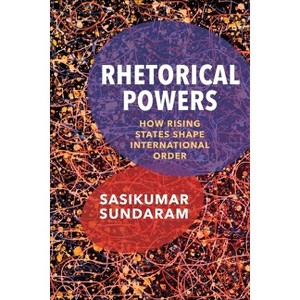
Rhetorical Powers - (Columbia Studies in International Order and Politics) by Sasikumar Sundaram
Pre-order
Sponsored
About this item
Highlights
- Recent years have seen a striking resurgence of anti-imperial and anticolonial rhetoric on the international stage, from Global South to Global North and from the Left to the Right.
- About the Author: Sasikumar Sundaram is a senior lecturer in foreign policy and security in the Department of International Politics at City St George's, University of London.
- 296 Pages
- Political Science, International Relations
- Series Name: Columbia Studies in International Order and Politics
Description
About the Book
Sasikumar Sundaram provides a bold new theory of rhetoric as power politics, demonstrating how non-Western states challenge their silencing within the Western-led international order.
Book Synopsis
Recent years have seen a striking resurgence of anti-imperial and anticolonial rhetoric on the international stage, from Global South to Global North and from the Left to the Right. Why do states deploy these forms of rhetoric in global politics? How do practitioners from the so-called non-Western world differ in their use and performance of rhetoric, and in what ways do they shape international order?
Sasikumar Sundaram provides a bold new theory of rhetoric as power politics, demonstrating how non-Western states challenge their silencing within the Western-led international order. He argues that, in the deeply hierarchical international system, states in the lower rungs resort to rhetorical performances in order to be heard. Through anti-imperial and anticolonial rhetorical statecraft, states such as India, Brazil, and China seek to expose and exploit the contradictions in the legitimating principles, norms, and rules of the international system--and, in so doing, pursue and exercise power. Today, as Russia, Europe, and even the United States engage in anti-imperial and anticolonial rhetoric, Sundaram shows why lessons from the non-Western world are crucial to recognizing the dynamics of power politics and global disorder. A bracing challenge to established theories of power in international relations, Rhetorical Powers underscores the need to address enduring forms of silencing within the international order.
Review Quotes
In a world in which great powers regularly trade accusations of imperial expansionism, Sundaram's exciting study of the functions of such rhetoric in international relations is a gift. His case studies of how Brazilian, Chinese, and Indian leaders have deployed such claims demonstrate that, far from being obsolete, anticolonial language has often portended a different and less hierarchical global order. Nevertheless, it is no less an issue of power politics.--Samuel Moyn, Yale University
While Getachew explored "revolutionary world-making" that ended in the 1970s, Sundaram brilliantly takes the story forward to 2020, showing how "rhetorical power politics" endures as a strategic repertoire of non-Western agency, whereby non-Western powers deploy anti-imperialist rhetoric to reveal the contradictions in Western practices and principles to upend the hierarchical liberal international order.--John M. Hobson, FBA, University of Sheffield
Sundaram's book is a fascinating account of how India, Brazil, and China have used anti-imperial rhetoric as a strategy for reversing the disempowering hierarchies of the international order and a stimulating explanation of why this form of rhetoric has become a permanent part of international politics.--Helen Thompson, Department of Politics and International Studies, Cambridge University
About the Author
Sasikumar Sundaram is a senior lecturer in foreign policy and security in the Department of International Politics at City St George's, University of London. He is the vice chair of the Global South Caucus of the International Studies Association.
Shipping details
Return details
Frequently bought together

Trending Non-Fiction