Sponsored
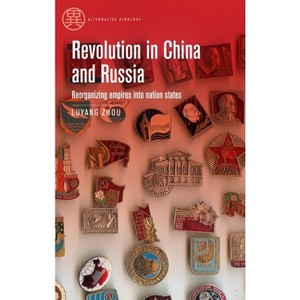
Revolution in China and Russia - (Alternative Sinology) by Luyang Zhou (Hardcover)
In Stock
Sponsored
About this item
Highlights
- This book compares how Russia and China maneuvered nationalism through communist revolutions and explains why they followed different paths in reorganizing empires.
- About the Author: Luyang Zhou is an Assistant Professor of Sociology at Zhejiang University
- 264 Pages
- Political Science, Political Ideologies
- Series Name: Alternative Sinology
Description
About the Book
This book compares how Russia and China maneuvered nationalism through communist revolutions and explains why they followed different paths in reorganizing empires.
Book Synopsis
This book compares how Russia and China maneuvered nationalism through communist revolutions and explains why they followed different paths in reorganizing empires.
From the Back Cover
The twentieth century saw the decline of traditional empires, yet some endured by adapting. This book compares how Russia and China navigated these transformations, each harnessing nationalism through communist revolution.
While Bolsheviks restructured the Tsarist empire into a union of distinct nation-states, Chinese revolutionaries reintegrated Qing territories into a unified state with autonomous regions. Despite this divergence, both revolutions were shaped by their leaders' strategic choices. Compared to the USSR's founding Bolsheviks, the Chinese communists were more ethnically homogeneous but less internationalist, seeking a self-contained polity rather than an expanding union.
Unlike the Bolsheviks, who dissolved Russia into the Soviet framework, the Chinese communists preserved China while embedding revolutionary ideals. Their prolonged struggle taught them to reconcile tradition with ideology and shaped their cautious approach to borderlands. Lacking the strength to dominate frontier regions, they rejected the Bolshevik strategy of weaponizing national self-determination.
This book explores the key features of China's communist revolution and their role in the country's transition to a nation-state: geographical isolation from external interference, bottom-up mobilization over a protracted struggle, and the enduring challenge of being the weaker side in conflict. It will be invaluable to scholars of revolution, empire, comparative historical sociology, and communist leadership in Russia and China.
Review Quotes
CHOICE Recommended: Graduate students, faculty and professionals.
-- W.G. Moss, emeritus, Eastern Michigan University
About the Author
Luyang Zhou is an Assistant Professor of Sociology at Zhejiang University
Shipping details
Return details
Frequently bought together


Trending Non-Fiction






Discover more options